Findings From An Educational Survey About Nuclear Disarmament
During her Summer 2026 program internship at the Ikeda Center, Becca Faber designed a randomized educational survey meant to help the Center, as well as other organizations interested in nuclear disarmament, to hone their messages and the way they frame and present their arguments to educate as many people as people about this vital cause. Here, she presents her findings on the impact of different types of information on swaying opinion.
Introduction
According to a poll conducted by Statista in 2019, nuclear disarmament does not rank in the twelve issues young people care the most about. (1) But why? Research suggests that young Americans have limited exposure to education surrounding nuclear weapons, leading to apathy surrounding nonproliferation and disarmament. (2) If this is the case, then can exposure to information surrounding nuclear weapons challenge these existing narratives and change opinions surrounding the importance of the issue? And, if so, what kind of information is most influential?
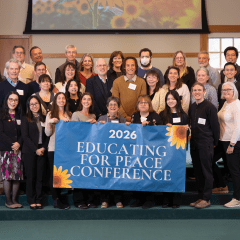
To assess whether exposure to information can influence opinions and thoughts regarding nuclear disarmament, I designed a randomized educational survey with support from my colleagues here at the Center. As many of the Center’s activities such as the annual Educating for Peace Conference and the August 7th Dialogue Nights focus on engagement and education surrounding the topic of nuclear disarmament, my hope was that this survey’s results could be practically applied to the way these topics are discussed and how these events are carried out. For organizations like the Ikeda Center, understanding how to engage the public in nuclear disarmament is essential to guiding existing activism and education efforts.
Survey Design and Collection
With input from Center staff, we created a survey asking respondents a series of questions related to nuclear disarmament and policy. The questions assessed the perceived likelihood of nuclear weapons use, likelihood and importance of abolishment, perceptions of the safety of nuclear weapons, and support for policies such as “No First Use.” One set of respondents was only given the set of questions by itself. Another set of respondents were exposed to an educational resource with humanitarian and historical information before receiving the questionnaire (labeled as Type A). For a third set of respondents, they were given educational information about the current state of nuclear weapons before receiving the same questionnaire as the first two groups (labeled as Type B). All groups were then asked demographic information such as age, gender, and how knowledgeable they were on nuclear weapons.
Whether a respondent received information and the kind of information they received was randomized using Qualtrics. Using university mailing lists, flyers, and tabling in Harvard square, the survey received 172 completed responses. Before analyzing the data, I ran randomization checks and found a balance of demographics and self-reported level of knowledge about nuclear weapons between all groups. This suggests that groups were generally equivalent before taking the survey.
After the data was collected, responses were compared using the control (no information) group as a baseline in R Studio. To measure outcomes, I used a five-point Likert scale where answers were assigned a number from 1 to 5 with 1 indicating one side of the spectrum of given answers (Extremely unlikely, Not at all important, etc.) and 5 representing the opposite side (Extremely likely, Extremely important, etc.). This allowed me to quantify the average responses per group. Using ordinary least squares (OLS) regression, with the control group serving as a reference, I then analyzed the differences in outcomes between groups. This allowed me to assess the impact of exposure to information on respondent attitudes surrounding nuclear disarmament and policy.
Results of the Survey: What the Data Says
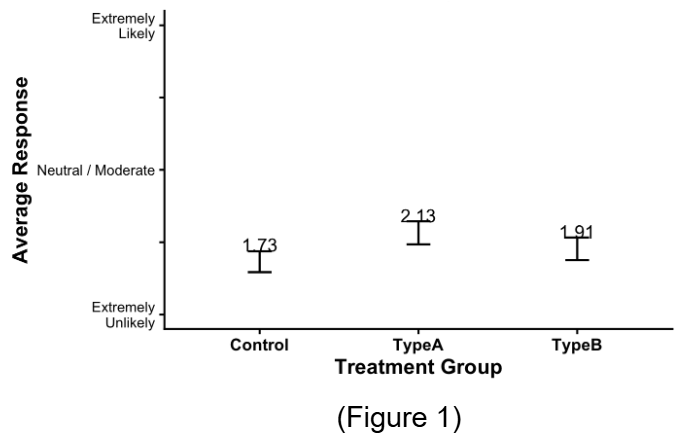
When analyzed, the results showed no meaningful statistical differences between the kinds of information presented and attitudes surrounding nuclear disarmament across most questions. This suggests that the kind of information respondents received did not have a strong impact on their opinions about nuclear weapons. The only exception was the historical/humanitarian treatment group (shown in Figure 1) which rated nuclear abolition to be more likely than the control group with marginal statistical significance (p < 0.10). This provides suggestive evidence that exposure to humanitarian and historical information can somewhat increase optimism surrounding nuclear abolition.
For all other questions, average responses were generally similar across groups. For example, respondents showed strong support for a “No First Use Policy” (Figure 2) and somewhat high perceived importance of nuclear abolition (Figure 3) regardless of the information they received.
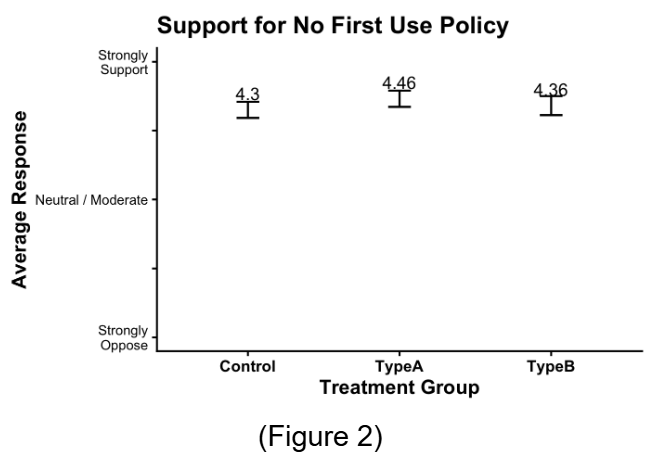
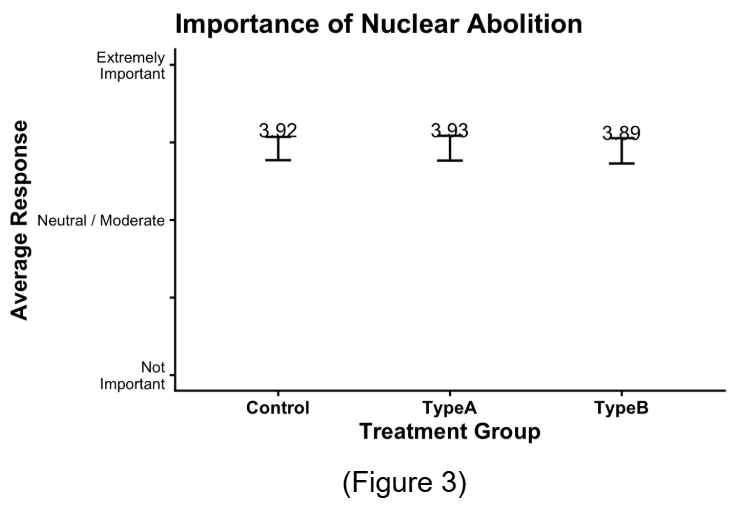
All together, these findings don’t provide strong evidence that short exposure to educational information can impact attitudes surrounding nuclear disarmament. These results are not surprising as research suggests political opinions are formed through long term information environments and preexisting beliefs as opposed to short educational interventions. (3) Even without statistical evidence, I believe there are still lessons to take away from this project as a whole and implications for the way the Ikeda Center carries out conversations surrounding this topic in the future.
Insights Beyond the Data
During our tabling session, Center staff and I were able to have conversations with some respondents after their completion of the survey. These conversations ranged from questions about the Center to the purpose of the survey to dialogues about the issue of nuclear disarmament itself. Some, like a group of high school boys, engaged in a spirited dialogue in front of us. Others, like a young man new to the area, stayed to chat with us for upwards of 15 minutes about the issue. For me, these conversations provided qualitative evidence of how open people were to discussing different aspects of nuclear disarmament and how we can engage in dialogue that promotes thinking deeper on this issue. In particular, many people we spoke with expressed that while they may view nuclear weapons as dangerous and something that makes the world less safe, they don’t believe nuclear abolition will ever happen. This shows an area where further intervention or education, such as highlighting achievements in the nuclear disarmament space, might be necessary in Center programming. Our survey results also show consistent opinions across questions of safety, no first use policies, and importance of nuclear disarmament, showing places of common ground that can lay the foundation for further conversation.
Implications and Takeaways
Even if the data itself did not provide specific evidence for a particular approach to education on this issue, it suggests that pursuing more sustained educational interactions could have a greater impact on attitudes and understanding. This aligns with the broader goals of the Education for Peace Conference (4), which seeks to create spaces for dialogue, deepen understanding of disarmament issues, and encourage participants to consider how education can contribute to a more peaceful and sustainable future. It can also inform places to start when having these conversations by showing the kinds of topics people generally agree on. In the future, I hope the Ikeda Center can incorporate this information into its future programs and conversations, using them to support sustained engagement and encourage greater reflection on issues of peace and nuclear weapons.
Notes
- Gen Z: most important political issues U.S. 2019 | Statista
- Undergraduate disarmament and nonproliferation education: gaps, opportunities, and new approaches
- PolBehavior-2010-Nyhan.pdf; The Nature and Origins of Mass Opinion
- The Educating for Peace Conference is an annual weekend-long gathering at the Ikeda Center that seeks to bring together and empower middle and high school teachers to explore effective ways to teach students about the threats and historical legacies of nuclear weapons and instill in them a sense of shared responsibility and commitment to safeguarding the future of humanity’s peaceful existence. Learn more here about the conference and its co-organizers.