Centering Humanity In Scholarly Disciplines
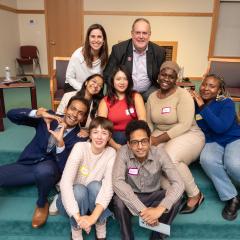
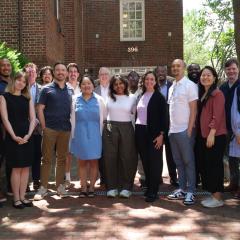
Called “Becoming Human Together: Hope, Healing, and Justice,” the 2026 Global Citizens Seminar asked participating doctoral students to engage with foundational questions such as how should we understand ourselves in relation to others, and does our identity as global citizens make certain ethical demands upon us and set particular parameters for effective action? Upon the conclusion of the seminar, the Ikeda Center asked scholars to reflect on the seminar and their own research by responding to the question: What would my discipline look like if it centered humanity in its work? Four participants responded with these brief essays.
***
Nathan Davis Hunt
School of Theology, Boston University
Ostensibly God (theo-) is the central subject of theology. However, much contemporary theology would agree that the human condition marks our primary methodological points of departure and return. Theology might be tempted to rest with self-satisfaction before the Ikeda Center’s incisive question: what would your discipline look like if it centered humanity in its work? Yet something richer is expressed by this urging. For Daisaku Ikeda, centering the human amounted to a revolutionary transformation of one’s “inner core” from which, grounded in a consciousness of our radical interrelatedness, a globally inclusive peace might be fashioned. In this sense, it flows from an imagination of the human and lived practices of being human which extend beyond the traditional confines of scholarship. What would it look like for the discipline of theology to center humanity in such a vulnerable and involved manner? I would like to pose three questions for my field which I hope will stimulate further reflective action in that direction.
First, what model(s) of the human are we centering? As a bicycle goes where the cyclist looks, so do we perform the social structures held in our imagination of human nature. Whether that nature is corrupt, divine, deficient, some blend, or more, we build the world to match our model. These theological constructs have had enormous ramifications in secular modernity. If selfishness is ineradicable, capitalism can insinuate itself as a utilitarian means to net good. If finitude is read as curse instead of blessing, technologicalism’s determination to overcome and eliminate limits becomes a path of salvation. Visions of eternal punishment justify carceral punishment. Human exceptionalism establishes dominance over and the exploitation of non-human nature. Each model, held exclusively, can lead to untold suffering. What dialectical images of the human might lead us toward the dialogical revolution of which Ikeda dreamed?
Second, does our discipline center humanity only as an intellectual process or a practice of interrelated bodies? Theory which is not experimentally enacted in the complex, contested field of real relations fails to undergo the rigor of praxis. Such was the essence of Marx’s critique of Hegel. A system which only resolves contradictions at the abstract level of mind has yet to overcome the sources of human suffering which occur in material life. Theology can center humanity when Ikeda’s charge to dialogue across difference becomes an embodied practice that leads to material commitments of solidarity.
Extending this commitment leads us to ask: with which particular group of human beings is our work accountable? All humanity cannot be centered in practice or research. Only deep fidelity to particularity makes available truths others might read with a transcendent sense of recognition. The ethic of Jewish and Christian scripture teaches that all will be well only when the “least of these” is well. Our discipline must continue seeking modes of relationship, pedagogy, and scholarship that accord with this responsibility. Who is the concrete vulnerable neighbor with whom our institutions, classrooms, and personal scholarship will commit to in and for accountability? Undertaking such work presses us as practitioners to continuously undergo our own revolutionary transformation: to enflesh those democratic virtues of prophetic courage, humility, perseverance, and forgiveness which solidarity requires. [See below for haiku composed by Mr. Hunt to capture the spirit of the day.]
Ymbar I. Polanco Pino
Civil and Environmental Engineering, Tufts University
If my profession of engineering were to truly center humanity, I think we would begin by asking not only “What can we build?” or even “What problem can we solve?” but “Who are we becoming through the things we choose to build?”
Engineering often speaks in the language of systems, efficiency, optimization, resilience, and risk. While these words are important, they can make the people living inside those systems disappear. A road can improve mobility while dividing a neighborhood. A flood barrier can protect property while determining whose property is considered worth protecting. Energy, water, housing, transportation, and digital infrastructure can all be technically successful while subtly transferring burdens onto people who had little voice in their design. Centering humanity would require engineering to recognize that infrastructure is never merely physical. It carries assumptions about whose time matters, whose health matters, whose history matters, and whose future is being imagined.
The seminar made me think more deeply about the idea that none of us becomes fully human in isolation. Our lives are entangled with the lives of others, and our disciplines should reflect that same interdependence. For engineering, this would mean approaching communities not as sites of need, datasets, or recipients of expertise, but as people whose knowledge is necessary to the work itself. The engineer would still bring technical knowledge, but with enough humility to understand that education is a privilege and expertise is incomplete without relationship.
Perhaps, then, a humane engineering discipline would measure success differently. It would still ask whether something stands, functions, lasts, or performs efficiently. But it would also ask whether people were heard, whether dignity was preserved, whether burdens were shared justly, whether culture and memory were respected, and whether a community possesses greater agency after our involvement than before it.
I do not think centering humanity would make engineering less rigorous. I think it would demand a deeper rigor. It would require the wisdom to recognize interconnectedness, the courage to encounter difference without trying to erase it, and the compassion to allow another person’s suffering to place demands upon our work.
Engineering would then become more than the construction of infrastructure. It would become one of the ways we practice becoming human together.
Eric Ross
Department of History, UMass Amherst
History and Humanity: Uses and Abuses
In the words of the late historian Alon Confino, “the power of historical storytelling is that it can open our minds to others as fully human. We cannot really change our mind—or shall we say, our heart—without telling a story. All good stories are necessarily political because identifying with the other is political.” This insight captures the subversive and emancipatory potential of history. This is its capacity to recover the humanity of those rendered distant or cast as other, whether by place, position, perspective, or time.
Yet this promise, that history can serve as a tool for cultivating tolerance and understanding, can hardly be taken for granted. History is a rigorous but interpretive discipline, shaped by competing claims about the meaning and significance of the past and present. This is precisely why it is so politically fraught. To move toward a more human-centered field, then, we cannot merely rely on the familiar truism that studying history prevents its most shameful episodes from recurring. History follows no inexorable teleology of progress, nor does knowledge of the past necessarily inculcate understanding or inoculate us against its repetition. Its humanizing potential must instead be actively cultivated through a concerted commitment to historical empathy and the recognition of our shared humanity.
Absent such an ethic, history can be a tool sued to oppress as readily as it can liberate. The violence of the past is often reduced to formulations such as Hannah Arendt’s observation that “evil comes from a failure to think.” Yet at the core of fascist movements, then and now, to which Arendt was referring was not a rejection of history outright but rather an obsessive appeal to a particular vision of it: the palingenetic promise of restoring a mythologized past. In such contexts, history becomes not an antidote to violence but a means through which violence is imagined and legitimated. This presents a far more complicated, and more unsettling, reality than the comforting assumption that acts of inhumanity proceed simply from ignorance of the past.
Ultimately, historians have an obligation to center humanity in the study of the past. History can help us construct a more empathetic, cooperative, and humane world, but there is nothing inevitable about that outcome. We must actively work toward it. Only then can the discipline fully realize its potential and promise as a means of collective understanding and liberation.
Evan Dietrich Gosen
Department of Sociology, Boston University
What would sociology look like if it centered humanity? In many ways, sociology already does. It is the study of both the human and the structures that humans create, literally and figuratively, to organize their lives. The founders of sociology each recognize this in their own way. Marx emphasized the human impact of capitalism and modern divisions of labor in his (and Engels’) German Ideology and Capital, and more fundamentally, claimed that “consciousness is … from the very beginning a social product” (Engels and Marx 1978: 158). Weber, in his Protestant Ethic and the Spirit of Capitalism ([1905] 2002), drew our attention to the ways in which human ideologies give rise to consequential, all-encompassing social structures (which then direct human activity). And Durkheim, the third ‘canonical father’ of sociology, points to the power of humans gathering, through which the very norms we claim to be universal are formed (Durkheim [1912] 2001). Humanity has been the core of sociology since its inception.
Yet these are not the only foundational sociologists. W. E. B. Du Bois, in his more sociological works Black Reconstruction in America and The Philadelphia Negro, critiqued the burgeoning field of study by introducing race – a relatively recent human construct, invented alongside capitalism (Williams [1944] 2021) – as a key element of sociological analysis: “the hurt to the Negro … was not only his treatment in slavery; it was the wound dealt to his reputation as a human being” (Du Bois [1935] 1998: 39). Returning to the original question, I argue that it was Du Bois who first truly centered humanity in his work because the crux of his writing was externally-imposed definitions of humanity itself. For this reason, I believe that centering humanity in sociology means attending to the ways in which humanity has been questioned, stifled, or systematically denied.
Historically, in America, full humanity was denied the enslaved African, and those born to them. In modern America, it is frequently the full humanity of the incarcerated that is denied, and here, too, along racial lines. Despite recent trends towards decarceration in America, Black people are still incarcerated at six times the rate of White – in 2022, Black people were incarcerated at a rate of 911 per 100,000 (almost one percent of all Black people in America) where the rate for White people was 188 per 100,000 (Wang 2024). Those who are released – and have a chance to ‘regain their humanity’ in the eyes of the public – exhibit, compared to those never incarcerated, higher levels of trauma (Pettus 2023), far higher levels of overdose-related mortality (Khatri et al. 2025), higher exposure to violence (Western 2015) and stress (Western et al. 2015), increased difficulty in finding employment (Pager 2003; Western and Sirois 2019), and an increased likelihood of (re)arrest and (re)incarceration (Harding et al. 2017). Yet many never will. Of the roughly 1.4 million people in state and federal prisons, one in seven – over 200,000 – are serving life sentences, and two-thirds of that 200,000 are people of color (The Sentencing Project 2021).
This is but one example of a group whose humanity has been denied in the national pursuit of “freedom,” on which our nation so exuberantly prides itself. Other groups, historically and presently, include women, members of the LGBTQ+ community, immigrants, and more. To center humanity, sociologists must ask: humanity for whom, and at whose expense?
Works Cited
Du Bois, W. E. B. [1935] 1998. Black Reconstruction in America. New York, NY: The Free Press.
Durkheim, Émile. 2001. The Elementary Forms of Religious Life. Oxford World’s Classics. Oxford ; Oxford University Press.
Engels, Friedrich, and Karl Marx. 1978. “The German Ideology: Part I.” Pp. 146–202 in The Marx-Engels Reader. New York, NY: W. W. Norton & Company.
Harding, David J., Jeffrey D. Morenoff, Anh P. Nguyen, and Shawn D. Bushway. 2017. “Short- and Long-Term Effects of Imprisonment on Future Felony Convictions and Prison Admissions.” Proceedings of the National Academy of Sciences 114(42):11103–8. doi:10.1073/pnas.1701544114.
Khatri, Utsha G., Jahn K. Hakes, David Buckler, Alexis Zebrowski, and Tyler Winkelman. 2025. “Individual- and Area-Level Incarceration and Mortality.” JAMA Network Open 8(6):e2513537. doi:10.1001/jamanetworkopen.2025.13537.
Pager, Devah. 2003. “The Mark of a Criminal Record.” American Journal of Sociology 108(5):937–75. doi:10.1086/374403.
Pettus, Carrie A. 2023. “Trauma and Prospects for Reentry.” Annual Review of Criminology 6(Volume 6, 2023):423–46. doi:10.1146/annurev-criminol-041122-111300.
The Sentencing Project. 2021. “America’s Enduring Reliance on Life Sentences.” https://www.sentencingproject.org/reports/no-end-in-sight-americas-enduring-reliance-on-life-sentences/.
Wang, Leah. 2024. “Updated Charts Show the Magnitude of Prison and Jail Racial Disparities, Pretrial Populations, Correctional Control, and More.” https://www.prisonpolicy.org/blog/2024/04/01/updated-charts/.
Weber, Max. [1905] 2002. The Protestant Ethic and the “Spirit” of Capitalism and Other Writings. edited by P. Baehr and G. C. Wells. New York, NY: Penguin Books.
Western, Bruce. 2015. “Lifetimes of Violence in a Sample of Released Prisoners.” RSF: The Russell Sage Foundation Journal of the Social Sciences 1(2):14–30. doi:10.7758/RSF.2015.1.2.02.
Western, Bruce, Anthony A. Braga, Jaclyn Davis, and Catherine Sirois. 2015. “Stress and Hardship after Prison.” American Journal of Sociology 120(5):1512–47. doi:10.1086/681301.
Western, Bruce, and Catherine Sirois. 2019. “Racialized Re-Entry: Labor Market Inequality After Incarceration.” Social Forces 97(4):1517–42.
Williams, Eric Eustace. [1944] 2021. Capitalism and Slavery. Third edition. Chapel Hill, NC: The University of North Carolina Press.
***
Haiku Notes from the Retreat by Nathan Davis Hunt
Human, all too human
And not yet human enough
For peace as justice
.
Being, doing me
In nation state, fates of hate—
Through you, new desires
.
How to make it seen
My freedom so bound to yours?
Do not be afraid
.
Relationship touches:
Breaks skin, suture wounds, births worlds.
Solidarity!
.
A revolution:
Flowers turned toward bright sun
Soft dialogue grows
.
Endlessly falling
Never does the stone lose height
Resting on all others
.
If failing is this—
wet beaks waiting on thin branches—
all things shall be well.