2026 Global Citizens Seminar: Becoming Human Together
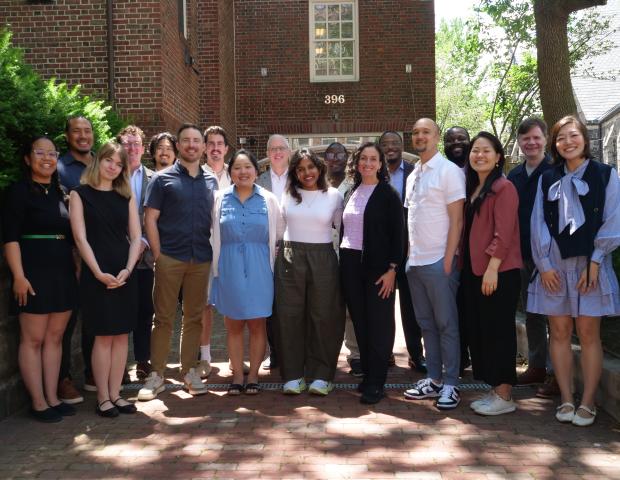
When the problems of the world threaten to overwhelm, sometimes it’s best to return to the basics. Called “Becoming Human Together: Hope, Healing, and Justice,” the 2026 Global Citizens Seminar, held on June 20th, did just that, asking participating doctoral students to engage with foundational questions such as how should we understand ourselves in relation to others, and does our identity as global citizens make certain ethical demands upon us and set particular parameters for effective action?
Now in its sixth year, the Global Citizens seminar series was founded to bring emerging scholars from diverse fields into dialogue across disciplines to reckon with the most pressing issues of our time. Inspired by and leveraging the enduring works of Center founder, Daisaku Ikeda, the series aims to support young scholars and provide critical and hope-filled perspectives for confronting therealities of a complex and interconnected world. Principal among these is the ethic of global citizenship. This year, the seminar was grounded in Mr. Ikeda assertion that
We are not born human in any but a biological sense; we can only learn to know ourselves and others and thus be ‘trained’ in the ways of being human. We do this through immersion in the “ocean of language and dialogue” fed by the springs of cultural tradition.
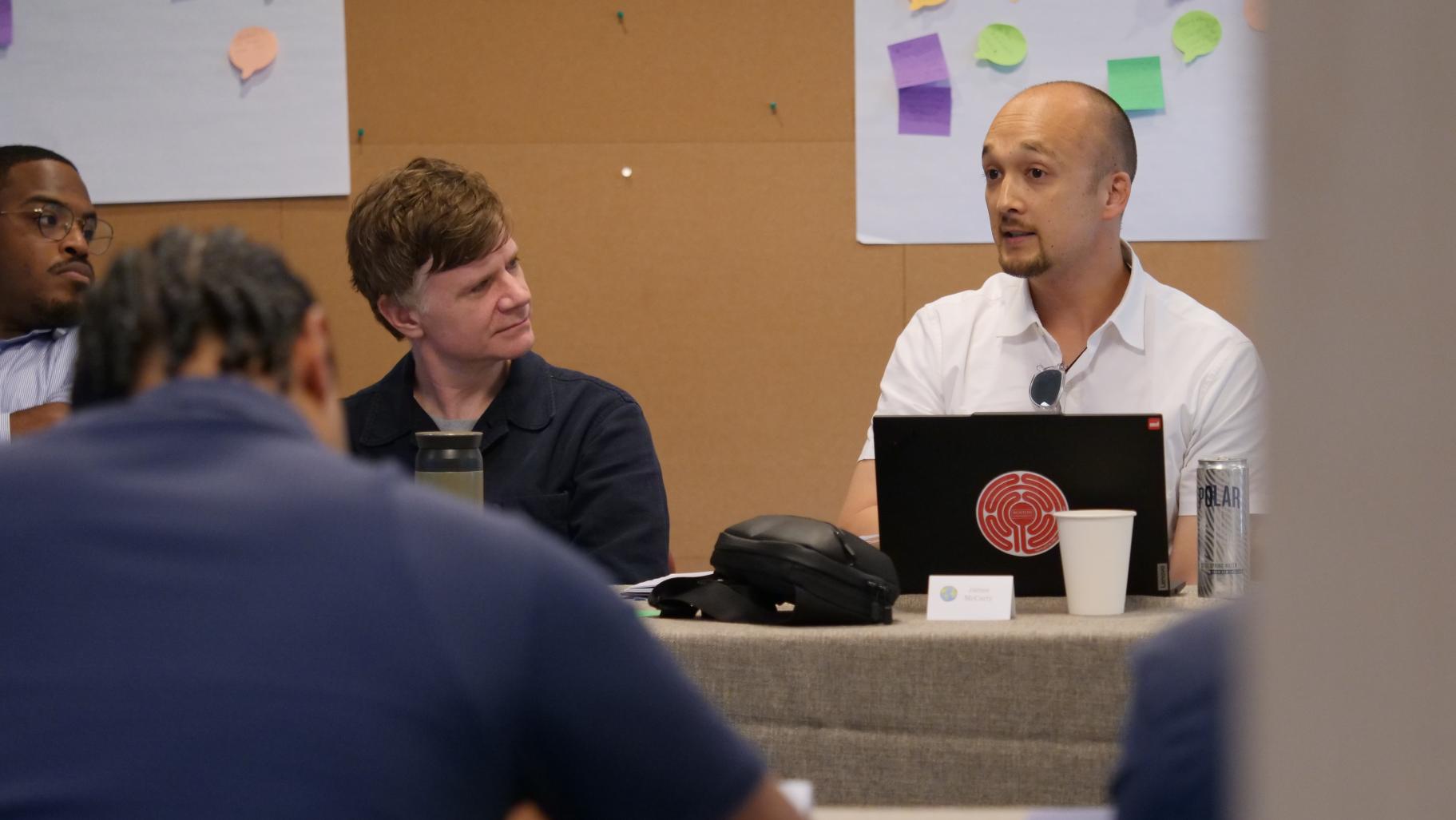
Guiding the participants in their investigations were two esteemed scholars. Jason Goulah is Professor of Bilingual-Bicultural Education and Director of the Institute for Daisaku Ikeda Studies in Education at DePaul University in Chicago. He is also director of programs in Bilingual-Bicultural Education, Value-Creating Education for Global Citizenship, and World Language Education at DePaul. James McCarty is a scholar, minister, professor, and community organizer with over twenty years of experience in congregational ministry, NGO leadership, grassroots activism, and higher education in both the United States and internationally. He is Clinical Assistant Professor of Religion and Conflict Transformation and Director of the Tom Porter Religion and Conflict Transformation Program at Boston University School of Theology.
Participating doctoral candidates were: Nathan Davis Hunt and Connie Bahng of the School of Theology, Boston University; Evan Gosen, Department of Sociology, Boston University; Alhassan Tahiru, Clara Nithiaparan, and Phil Ekeokocha, Global Governance and Human Security, UMass Boston; Eric Ross, Department of History, UMass Amherst; Ymbar I. Polanco Pino, Civil and Environmental Engineering, Tufts University; Joseph Wilson, Harvard Graduate School of Education; Elena Burke, program in Value-Creating Education and Global Citizenship, DePaul University.
Welcoming Remarks
The day opened with welcoming remarks from Center executive director, Kevin Maher. The original impetus for the annual seminar, he said, came from the desire to create a space for interdisciplinary dialogue between scholars and to create discussions that are facilitated yet open ended and that allow scholars to bring work and personal experiences into conversation. In fact, it is this latter quality that truly distinguishes the seminar and all the work of the Center: scholars are invited to bring their whole selves to the dialogues. As for guiding content for this year’s seminar, the main source material was the lecture Mr. Ikeda delivered at Teachers College, Columbia University, in 1996, called “Thoughts on Education for Global Citizenship.” In addition to this lecture, the other main source for this year’s seminar was Desmond Tutu’s “In God’s Hands: The Archbishop of Canterbury’s Lent Book 2015.” These were joined as secondary readings by Ikeda’s essay “What Is Human Revolution,” Dr. McCarty’s article “From Service to Solidarity: On the (Im)Possibilities of Liberative Service-Learning,” and Dr. Goulah’s “Ikeda Daisaku and African American Pragmatism: Race, Identity, Justice and Cosmopolitan Becoming in the Dewey-Soka Heritage.”
Speaking next, Dr. Goulah provided an introduction to Daisaku Ikeda’s life, work, and philosophy, highlighting that his work has spanned from religious leadership to education, including as founder of Soka University in Japan and Soka University of America. He was also a prolific author and lecturer. And above all, he was a tireless dialogician, engaging in hundreds of dialogues with notable scholars, artists, religious leaders, and public figures worldwide. Many dozens of these dialogues have been published in book form. Among the key ideas of Mr. Ikeda that Goulah touched on was that of “human revolution,” or the inner transformation of oneself toward personal, interpersonal, and social good. Specifically, Ikeda’s mentor, Josei Toda, saw the idea of human revolution “as resonant with the ideals of Buddhist humanism,” including “that Buddhism is about transforming your life from within to effectuate change externally.” He also talked about the question informing the seminar, one important to Mr. Ikeda and Buddhists in general: How do we understand that our life is fully intersecting with the lives of others? And how do we leverage that and create meaning that serves oneself and others in that kind of way?
For his opening remarks, Dr. McCarty compared the ideas of Mr. Ikeda with those of Reverend Tutu, especially notions of becoming human and questions of what it means to be human together. He was especially intrigued by Ikeda’s conviction that “becoming human is a formational process.” Often in human rights discourse, he observed, “it is just asserted that there’s something special about humans, and humans carry that with them.” But Ikeda’s assertion “that we can be more or less human with one another,” raises interesting parallels with Tutu’s advocacy of the South African concept of human interdependence, ubuntu. And the import of these ideas extends beyond these two men. “The folks we look to as our prophets and our saints, said McCarty, “regularly point to the ways that we’re interwoven in one another’s lives.” For today, he said, “my invitation to you all is, is to enter a dialogue” with Ikeda and Tutu. “Wrestle with the ideas, play with the ideas. See if they’re relevant, and if so, how, and if not, why not, to the work and research that you’re doing.” And, more than that, he hoped that participants would form “relationships that extend beyond this [seminar].”
Origin Stories and Generative Questions
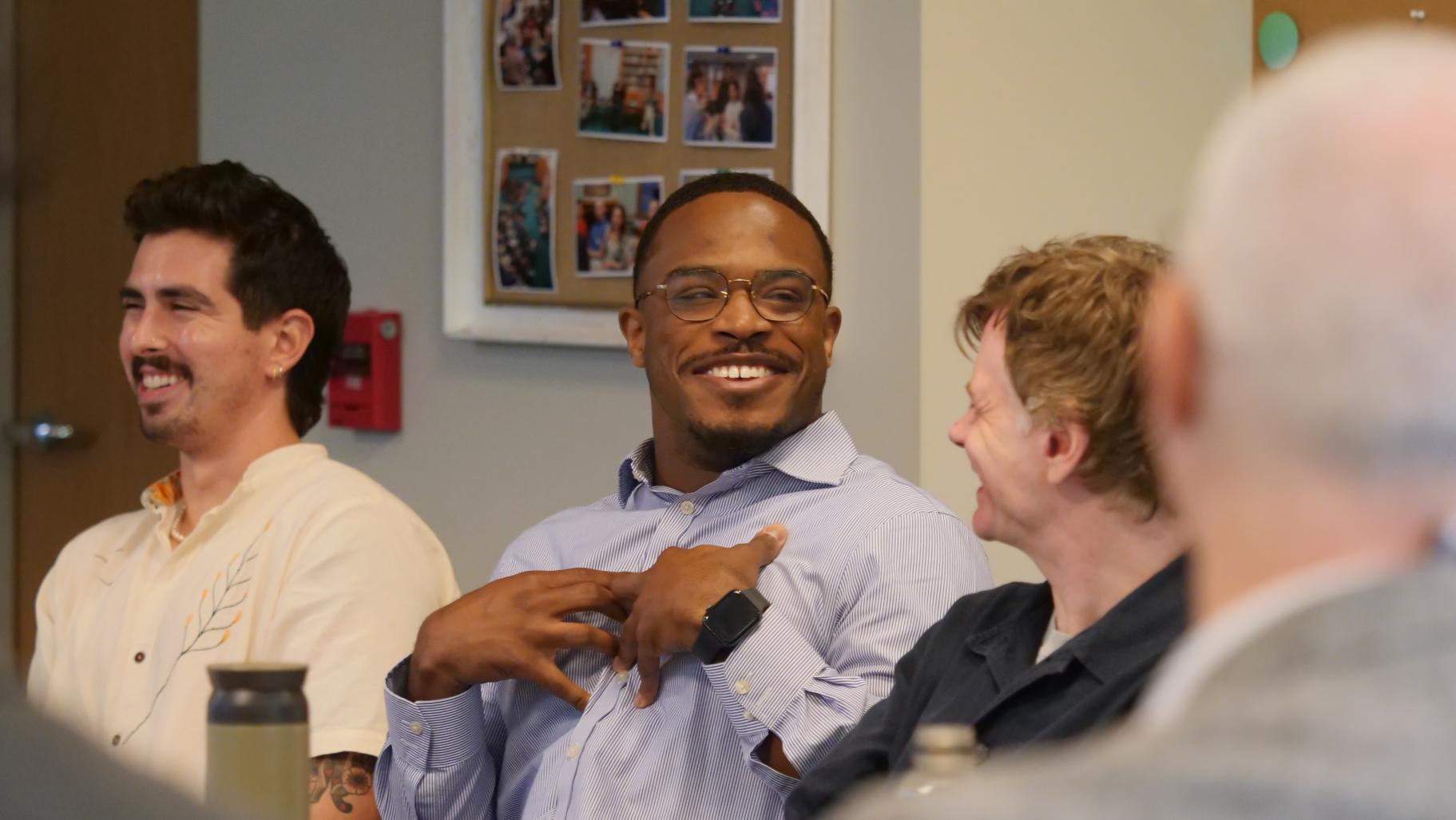
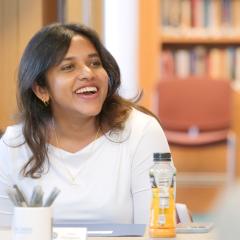
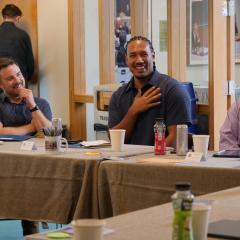
Central to Ikeda’s conception of global citizenship is the idea that one’s having lived abroad or traveled extensively is not essential to being a global citizen. Rather it is found in the ability, no matter where one lives, to develop wisdom, courage, and compassion.* Nevertheless, having together in one room people of so many different nationalities and cultures demonstrated the dynamism of this particular aspect of global citizenship. During the opening full group discussions session, each participant shared the formative dimensions of their youth that started them on the journey toward their current studies and their educational, ethical, and social concerns. These stories were accompanied by one meaningful photograph the participants selected in advance to share with the group.
The richness of their “origin stories” defies quick encapsulation, but hearing twelve unique individuals tell theirs suggests that all of us possess inner lives that are both complex and contain the impetus for what we hope to achieve in life. Some told of how they were raised in conservative religious households but were drawn to cultivating spiritualties that were more outward facing and accepting and supporting of others, especially those who are struggling. Others emerged from environments defined by violence determined to work for peaceful coexistence both in their places of origin and globally. Another theme was the challenge of finding community and affirming and expanding one’s identity in places far from one’s birth home. Some mentioned feeling compelled to perform meaningful work in this world, causing a reconsideration of career paths. All in all, participants were able to embrace change in their own lives as they sought to effectuate positive change socially.
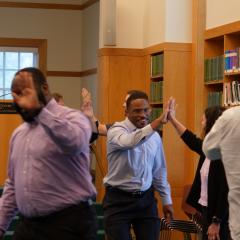
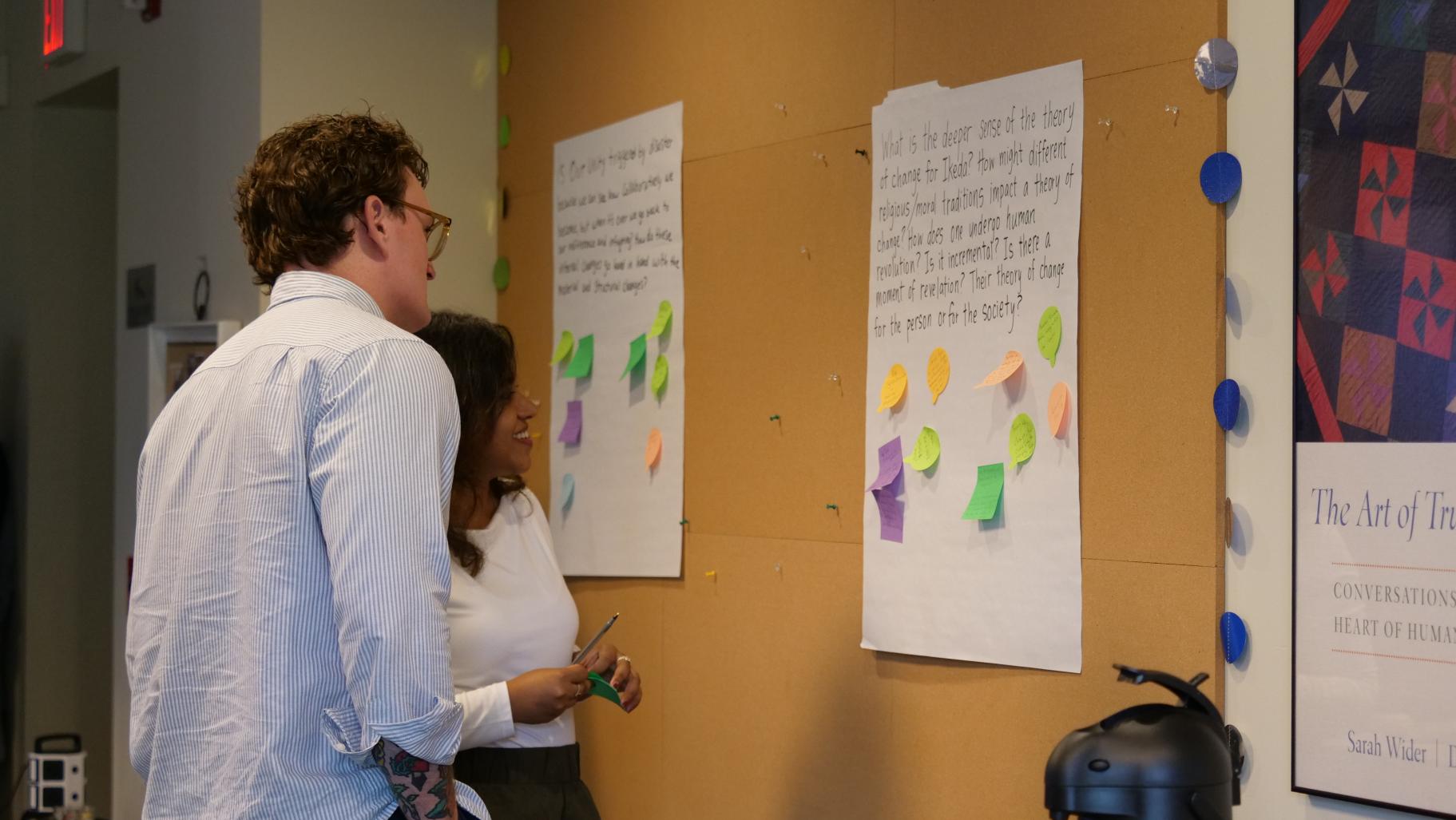
After the origin stories session, and as a way to stimulate ideas for the afternoon discussion, participants paired up to discuss the core questions that had arisen for them as they read the seminar’s guiding texts. These questions then formed the basis for a “gallery walk” in which participants moved around the room in pairs to engage with the questions, which had been posted around the room on large easel sheets. During their time with each question, everyone was invited to write their impressions and responses beneath the following queries:
- How much of our identity is tied to our citizenship?
- How could our disciplines construct humanity?
- How do you have internal individual change and how does that actually happen when you have real structures of power?
- How do you persist despite failing at the very thing we are hoping to do?
- Is our unity triggered by disaster because we can see how collaborative we become, but when it’s over, we go back to our indifference and infighting? How do these internal changes go hand in hand with the material and structural changes?
- What is the deeper sense of the theory of change for Ikeda? How might different religious/moral traditions impact a theory of change? How does one undergo human revolution? Is it incremental? Is there a moment of revelation? Their theory of change for the person or for the society?
Afternoon Discussion: Human Identity and Human Transformation
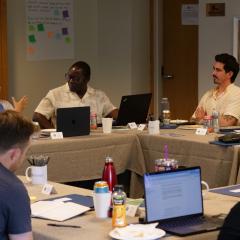
The afternoon discussion opened with Dr. Goulah inviting topics for discussion. “It can be with something you really feel positively about, something you have a question about, something you need more insight on, something you’re resisting … it can be anything.” One participant citied Desmond Tutu’s concept of what can be called inbuilt insufficiency, which holds that “none of us could ever be human in isolation” – we need the presence and help of others. She connected this idea with Dr. Paul Farmer’s reflection that the more he struggled and failed to get more hospitals built in areas of intense suffering “the more I become more in solidarity with who the world considers losers … or the defeated.” One implication of this, she said, is that “these things that we consider bad or judge as bad can actually be quite the opposite. There is a way in which we stand with the losers, they’re not losers anymore.” Another participant added a reflection on the nature of failure, saying that one thing he has learned from his practice of “centering prayer” is that every time we stray from or fail to live up to our purposes and values can be seen as an opportunity for return and reconfirmation of what matters most to us.
A related topic that the seminar explored in depth was what are the modes of positive change – is there a “theory of change” — for individuals and communities that are in systems with oppressive structures, or at the very least significant numbers of people who struggle. Here, one participant cited Frantz Fanon, the widely-read thinker in decolonization-related fields. For Fanon, who, writing as an advocate for Algerian independence from France in the late 50s and early 60s, proposed that violence against oppressors can actually be a proactive way to reconstruct your identity and reclaim your humanity. Other participants said that while the circumstances of each country vary, there does run the risk of, as Dr. McCarty phrased it, of simply “reversing the colonial view” and exercising power as it was “done before by the other.” As an example, one participant cited the current situation in South Africa where the formally oppressed have turned the tables and have been dehumanizing and attacking minorities. As an African, he said this situation was personally painful for him, adding that this shows the need for human revolution on the personal level to be an essential aspect of social change, otherwise the result is to “continue to reproduce the same system.”
This episode also showed how the simple reversal of oppressive activity has a negative impact on the state of interrelationship and interdependence that defines not only human but all life. Indeed, as Dr. McCarty noted, a leader of the violence in South Africa has even said, “Ubuntu is suspended until further notice.” This rather glib statement is a rejection, of course, of Desmond Tutu’s championing of this Zulu and Xhosa principle, which holds that “I am because we are” – a formulation that is a pure distillation of what Buddhists such as Daisaku Ikeda call dependent origination. For Ikeda, said Dr. McCarty, because our lives are fully intertwined, what we call good can be defined as that which moves us in the direction of “creative coexistence” and what we call evil is that which clings to “an unreasoning attachment to difference.” It is this conviction that guides Mr. Ikeda’s commitment to dialogue.
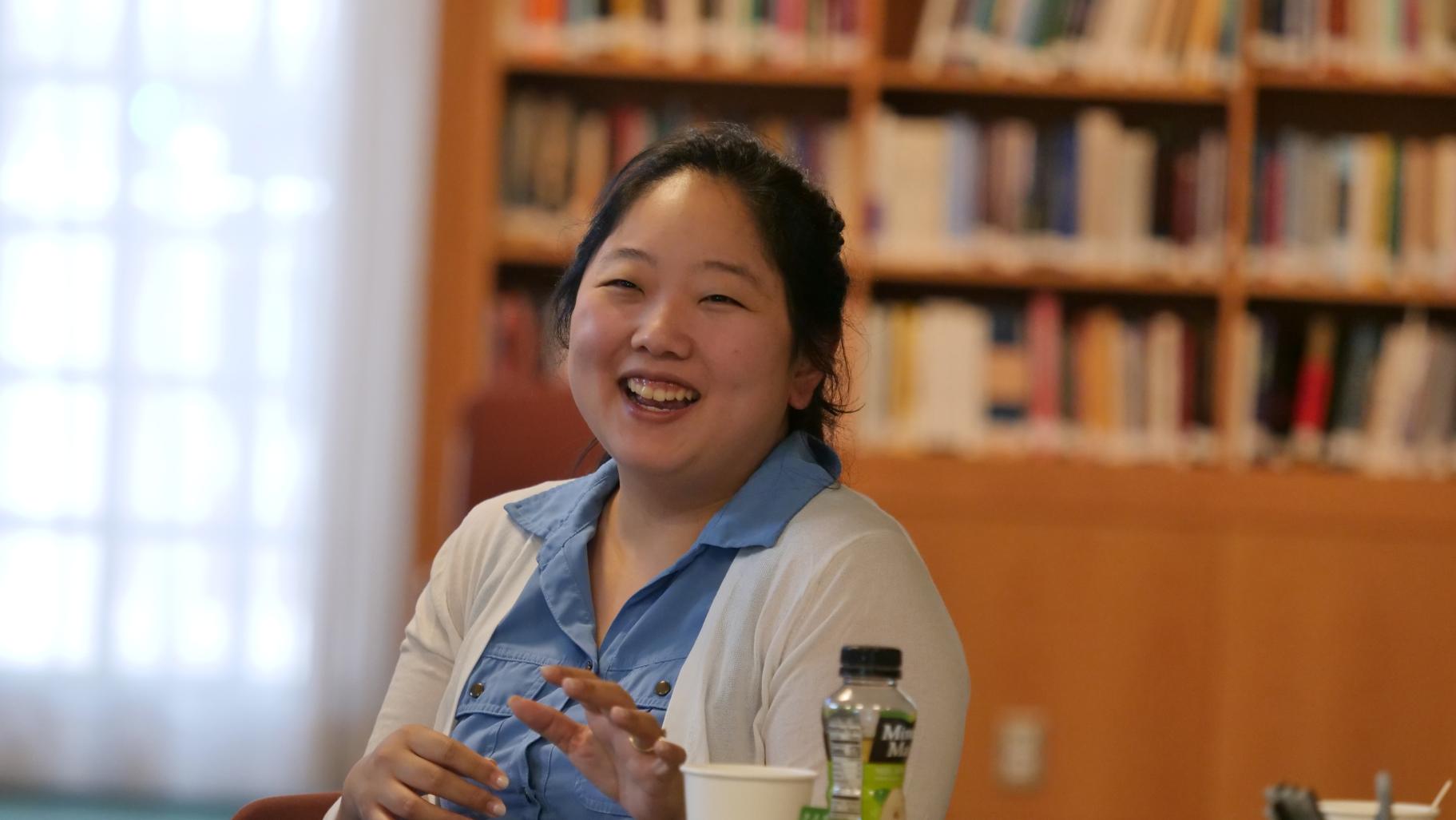
Yet, wondered one participant, is dialogue a strong enough tool in the endeavor of confronting power imbalances and oppressive state power? Acknowledging this tension, Dr. Goulah explained Ikeda’s conception of global citizenship is, in essence, not political. Rather it focuses on value creation, which asks: “What kind of meaning can we create from cognition of the facticity of the world, of our reality, that serves myself and yourself and the whole of humanity?” And his sense of interrelationship even goes beyond the structures of this world. What Ikeda wants us to do is see ourselves as “interdependent with the whole cosmos.”
With interrelationship serving as a through line for the discussion, participants also discussed its implications for our shared humanity according to their own faith traditions. Speaking as a Christian, one participant said that in his faith the “way we become fully and truly human” is through service toward others, especially those that suffer – those “losers” referenced at the beginning of the discussion. The key personal attribute here, he said, is that of humility, which connects as well to Ikeda’s notion that “education is a privilege.” We must humble ourselves, he said, if we are truly to learn from one another. Another participant equated this stance with the Buddhist ideal of the bodhisattva, who is motivated by “a profound faith in the goodness of people.” So, for Buddhists, she said, this means always seeking to address people with kindness and respect as a way of encouragement. It also means providing people with what they need to succeed in life. And most of all, it means being committed to the “unleashing of creative positive potential” of all people.
Finally, participants considered what this task of “becoming human together” tells us about our fundamental identities as persons here on earth. The core question was whether there is an essential nature of the human being or whether it is always in flux. If we consider Buddhism and Christianity, the religions represented by Ikeda and Tutu, we see that there are indeed fundamental identities. For Buddhists, there is the conviction that all persons have an inherent “Buddha nature” that contains the potential of enlightenment for oneself and all people. And, as one participant put it, Buddhists hold that each of us possesses an “inner space” that, while not unchanging, can thrive in ways not shaped by the expectations of our social structures. For Christians there is the concept of the Imago Dei, which holds that all people are created in the likeness of God. But at the same time, both Ikeda and Tutu hold that we continually are changed and create change through our relations with others. Negatively speaking, observed Dr. McCarty, “we become less human” when we conform to the “domination” model that depends on, as Dr. Goulah phrased it, “dehumanizing the other.” But on the other hand, as Goulah observed earlier, from Ikeda’s Buddhist perspective our unique human revolution is by definition a mode of positive change for self and other.
Next Steps and Closing Remarks
Each year, the seminar closes with the gathered scholars brainstorming a project that they can pursue together that will extend the ideas and community that were sparked during the seminar. Among many ideas that came up in the brainstorm as possibilities, they landed on exploring the question “What would your discipline look like if it centered humanity in its work?” Following the seminar, participants will write up their reflections on this question, and their responses will be published at a future date on our website.
As the seminar came to a conclusion, the moderators took the opportunity to share thoughts of appreciation. First, McCarty offered his thanks for “engaging one another across all kinds of academic differences in ways that just felt supportive and critical and challenging in all of the best forms.” Goulah added that I think “it says something about the nature of your character that you would come to a place” you aren’t necessarily familiar with “to engage in dialogue” about new topics and in ways that would only become apparent as the day unfolded. Finally, Kevin Maher offered his “appreciation” for “a really wonderful, enriching discussion, far exceeding our expectations,” adding that “I hope our connections can continue beyond this space.”
* In full, Ikeda’s attributes of global citizenship are:
- The wisdom to perceive the interconnectedness of all life
- The courage not to fear or deny difference, but to respect and strive to understand people of different cultures and to grow from encounters with them
- The compassion to maintain an imaginative empathy that reaches beyond one’s immediate surroundings and extends to those suffering in distant places