Ms. Keiko Ogura's Message to the 2026 Educating for Peace Conference
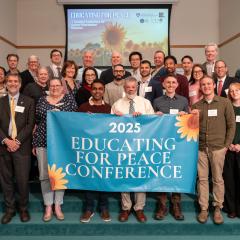
In April 2026, Ms. Keiko Ogura, a Hiroshima hibakusha, sent the following message to the participants of the 2nd annual Educating for Peace conference.
Ms. Keiko Ogura’s Message
The Second Sino-Japanese War began in 1937, the year I was born. At that time, the Army headquarters was located in the center of Hiroshima City. The dream of young boys was to become army officers riding on horseback, while girls aspired to become military nurses.
Our teachers taught us, “Japan is strong. Our brave soldiers will protect our homeland.” They never taught us the terror or the tragedy of war. As a young child, I used to sing the military songs of the Kamikaze pilots—the “Special Attack Corps”—who bravely sacrificed their lives for their country.
As the Pacific War escalated into a war of aggression across Asia, both education and the media became entirely consumed by the war. Higher-grade elementary school students were evacuated en masse to temples in the countryside, while middle school students remained in the city, working alongside soldiers in factories and on farms. Eventually, American bombers began flying overhead, and soon after, low-flying fighter planes began strafing us with machine guns. The sheer terror of the possibility of “being shot and killed from the sky” became a trauma that haunted me for decades.
On the morning of August 6, 1945, an atomic bomb exploded in the sky above Hiroshima. The seven rivers flowing through the city brimmed with corpses and dying people, eventually washing them out to sea. In an instant, people were horribly scorched by heat rays, buildings were destroyed by the blast, and generations to come would suffer from the effects of radiation.
I was exposed to the bomb 2.4 kilometers away from the hypocenter. Even there, people looking like ghosts flocked toward us, begging for water. Right after drinking water from my hands, two people died directly in front of me. The guilt etched into my young mind—the thought that “perhaps I killed them”—became a trauma so deep that for decades I could not speak of my A-bomb experience.
With the threat of nuclear weapons rising once again in the world, every day many international visitors come to the Hiroshima Peace Memorial Park. Those who learn the reality of nuclear weapons at the Peace Memorial Museum have the powerful realization that no one can ever survive such inhumane weapons.
The most important element in disarmament education is being able to imagine the pain of others. If a child is crying far across the ocean, can we feel their tears as our own? If a nuclear weapon was dropped on this city, what would happen to our beloved families? I believe that increasing the number of people who can imagine such specific pain and suffering—even by just one person—is the greatest deterrent toward ensuring nuclear weapons are never used again.
That is exactly why I have a serious request for all of you educators. I want you to foster critical thinking in children—the ability to question the information they are given, the capacity to feel with their own hearts, and a free intellect that empowers them to raise their voices when they think something is wrong.
I am no longer young. But I have not lost hope. Because education is hope itself. A single word you speak in your classroom might build the “defenses of peace” in the heart of one single child. In the coming era, as the voices of the Hibakusha fade away, I ask that each and every one of you become a storyteller—for me, and for Hiroshima.
To sever the chain of hatred and possess a heart that truly cherishes others. That is the ultimate disarmament, and the true purpose of peace education. Let us sow these seeds together, so that the children of the future can live in a world where they know neither the terror of radiation nor the sorrow of war.