- Home
- Books
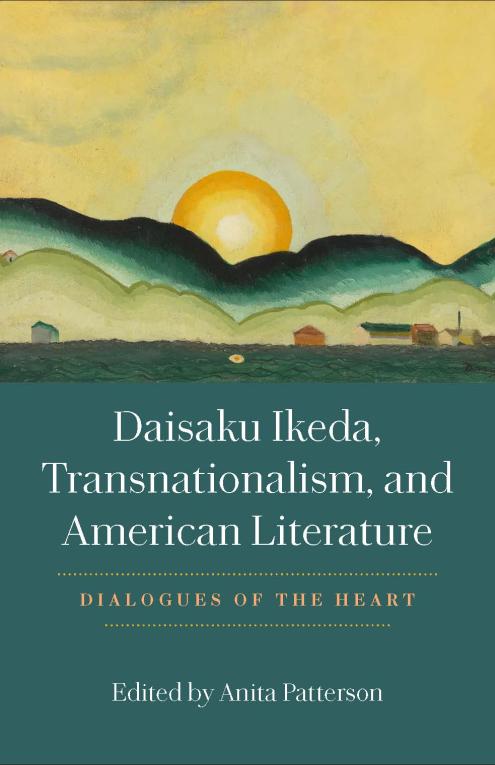
Daisaku Ikeda, Transnationalism, and American Literature: Dialogues of the Heart
To order the hardback or e-book, please visit the Routledge website. A softcover version is coming soon.
ISBN: 9781041093459
We are pleased to fulfill requests for complimentary exam copies from professors. To request a copy, please email Anri at akhare@ikedacenter.org with 1) your name, 2) your university or institution, 3) course name and number, and 4) semester.
Daisaku Ikeda, Transnationalism, and American Literature: Dialogues of the Heart examines the writings of Nichiren Buddhist philosopher, poet, and peacebuilder Daisaku Ikeda (1928–2023), focusing on how American literature and transnationalism are integral to the development of his Buddhist philosophy as well as his global endeavors in peacebuilding, inter-faith dialogue, and humanistic education.
Each chapter explores his engagement with a diverse array of literary texts, from Emerson, Whitman, and other authors of the American Renaissance to the philosophical pragmatism of John Dewey and Martin Luther King Jr., African American literature by Ralph Ellison and Langston Hughes, and a global culture of letters by Muriel Rukeyser, Ben Okri, and others. Throughout, contributors demonstrate the transformative power of literature and philosophy, not least their capacities to inspire dialogue, both internally within each reader but also among individuals of varied backgrounds. Other topics addressed include how poetry enables a pragmatist call to social action and how Buddhism inspired avant-gardism in American literature in general and Black literature in particular in the United States, as well as in Africa.
This edited volume utilizes a range of methodologies to study Ikeda, including a historicist analysis of Ikeda’s evolving engagement with American literature, the application of literary theory and philosophy to Ikeda’s work, and comparative analyses of Ikeda’s views with other thinkers, as well as analyses of Ikeda’s poetry alongside that of other poets.
Book editor Anita Patterson is Professor of English at Boston University, USA. She is the author of From Emerson to King: Democracy, Race, and the Politics of Protest and Race, American Literature and Transnational Modernisms. Among her many published journal articles and book chapters is her contribution to Hope and Joy in Education: Engaging Daisaku Ikeda Across Curriculum and Context, called “Restoring Hope for the Humanities: Daisaku Ikeda, Intercultural Study, and College Classroom Experience.”
Daisaku Ikeda’s Dialogues of the Heart: An Introduction
Anita Patterson, Boston University
- “In the Palace of My Heart”: The Presence of the American Renaissance in Daisaku Ikeda’s Lyric, Pragmatic Poetry of Peace
Ronald A. Bosco, University at Albany, State University of New York - A New Errand Bearer: Daisaku Ikeda’s Poetic Response to Walt Whitman and His Quest for Peace
Kenneth M. Price, University of Nebraska - Lincoln - The Poem as Dependent Origination: Daisaku Ikeda, Walt Whitman, and Reader Response
Jim Garrison, Virginia Tech University - “The World Globes Itself in a Drop of Dew”: Emerson’s and Ikeda’s Short Poems
Sarah Wider, Colgate University - Understanding Daisaku Ikeda’s New Renaissance: An Apprenticeship in Transnational Reading
Giulia Pellizzato, DePaul University - The Dance of the Buddha and a Poetics of Peace in Daisaku Ikeda and Muriel Rukeyser
J. Ashley Foster, California State University, Fresno - Daisaku Ikeda’s Literary Selfhood in the Justice of Becoming: Toward the Second American Renaissance and the Dawn of a New Global Age
Jason Goulah, DePaul University - The New Human Revolution: Daisaku Ikeda’s Engagement with African and African American Poetry
Masumi H. Odari, University of Nairobi, Kenya - The Dialectics of Nonviolence: Daisaku Ikeda, Buddhist Empathy, and African American Liberation Thought
Ikea Johnson, Salve Regina University
Excerpt from Editor Anita Patterson’s Introduction to the Volume
Engaged Buddhism: Dialogues of the Heart as a Peacebuilding Practice
I am drawn to Ikeda’s dialogues of the heart with Emerson and others as a means of fostering peace and intercultural understanding, in part because of the experience of my own Japanese American mother during World War II. In May 1943, she and her family boarded a bus and were evacuated to an internment camp in Poston Arizona. During her internment she was awarded a scholarship to spend her senior year at the Cambridge School in Weston, Massachusetts. Little did she know that she would go on to matriculate at Radcliffe College, where she would major in biology and graduate in 1949, and be just one of seven women to enter Harvard Medical School the following fall. In a treasure trove of documents related to my mother’s life, I discovered an essay she had written in 1944 about T. S. Eliot for a class at the Cambridge School. Eliot, who was influenced by both Buddhism and Emerson, is a poet I have cherished and studied for decades (Patterson 23–44). Like Ikeda’s burgeoning “friendship” with Emerson, my mother’s reading of Eliot initiated a crucial, formative intercultural dialogue just months after her internment in Poston, during a period of war and intense discrimination against Japanese Americans in the US. Thus I was delighted to learn how, in his 1984 lecture on “Humanity in Education,” Ikeda praised Eliot’s view that “culture is living,” and that education must broadly cultivate individuals so that they become “truly international” (Light of Learning 96).
Ikeda’s reflections on American literature have not only inspired and vitally enhanced my own dialogues of the heart with Emerson and Eliot. They have also raised my awareness of Buddhist resonances in the philosophy and peacebuilding legacy of Martin Luther King Jr. In America Will Be! Conversations on Hope, Freedom, and Democracy, a series of groundbreaking conversations with the historian of social transformation Vincent Harding published in 2013, Ikeda explores how King’s ideal of a “beloved community”—where all life is inter-related in an “inescapable network of mutuality, tied in a single garment of destiny” (“Letter” 290)—affirms the fundamental Buddhist idea of dependent origination (217). Four years earlier, in another published dialogue, with Harvey Cox, titled The Persistence of Religion: Comparative Perspectives on Modern Spirituality in English, Ikeda commented that “Buddhists identify the struggles of…King” with the attitude a bodhisattva described in the Lotus Sutra named Never Disparaging:
He tells everyone, ‘I have profound reverence for you. I would never dare treat you with disparagement or arrogance. Why? Because you are all practicing the bodhisattva way and are certain to attain Buddhahood. Although people ridiculed him and attacked him with sticks and stones, he simply went about bowing to them and continued his non-violent practice. (63)
As Ikeda and numerous scholars including myself have observed, Dr. King was profoundly influenced by Thoreau and Emerson, as well as the philosophy and political activism of Mahatma Gandhi, who, by his own account, read Thoreau in 1908, when he was incarcerated in South Africa and subsequently claimed to have “endeavored humbly to follow…Thoreau, Emerson and other writers, besides masters of Indian philosophy” (6; Parel 373). Reading Ikeda has opened new possibilities in my encounter with King’s writings: I recently discovered, for example, that in 1950, while he was a student at Crozer Theological Seminary, King wrote a research paper for a course on the “History of Living Religions” that explored fundamental tenets of Mahayana Buddhism, where he expressed a view very similar to Ikeda’s in comparing the attitude of the Bodhisattva as an ethical ideal with Christian conceptions of vicarious suffering and the transference of merit:
The ethical ideal of the Mahayana is the Bodhisattva [,…] the ideal of the earnest seeker after the welfare of others, who in unselfish devotion to his fellow creatures accumulates great stores of merit and dedicates it not to his own salvation but to that of all suffering beings…. There is also the element of vicarious suffering in Mahayana religion. The Bodhisattva is able to present his merit to a needy world, and for its sake he is willing to be a meritless sinner. It is interesting at this point to note the similarities of this conception of vicarious suffering and the transference of merit to many of the theories of atonement that have appeared in the history of Christian thought. (“Mahayana Buddhism” 322–23)
There is a growing scholarly interest in “engaged Buddhism,” a phrase that was coined in the 1960s by Thich Nhat Hanh, a Vietnamese Zen Buddhist monk who was nominated for the Nobel Peace Prize by Dr. King because of his social activism during the Vietnam War, to denote the application of Buddhist teachings to the resolution of social problems, such as providing a foundation for achieving Black liberation (Queen 1). In Being Peace, one of his first books published in the US, Nhat Hanh writes,
Meditation is not to get out of society, but to prepare for a reentry into society. We call this ‘Engaged Buddhism.’… How do you expect to leave everything behind when you enter a meditation center? The kind of suffering that you carry in your heart, that is society itself. You bring that with you, you bring society with you…. Meditation is not an escape from society. Meditation is to equip oneself with the capacity to reintegrate into society, in order for the leaf to nourish the tree. (43–45)
Christopher Queen has argued that although
one of the marks of engaged Buddhism as a worldwide movement has been its grassroots collectivism, an emphasis on the social action of committed groups,…it is also true that Asian Buddhist leaders like…Daisaku Ikeda have personally shaped the direction of the Dharma in our time. (98)
David Chappell has observed that membership of SGI-USA (Soka Gakkai International in the United States of America) has twice the percentage of Black Americans present in the population as a whole, in contrast with all other Buddhist groups in the US, where Black Americans are “severely underrepresented,” and this can be attributed to “its attention and care to the needs of members, its concrete practices, and visionary purposes that reach across color barriers,” as well as Daisaku Ikeda’s championing of heroes in the struggle for racial equality such as Nelson Mandela, Rosa Parks, and Sojourner Truth. “By asserting that individual happiness could not be complete without the happiness of others,” he concludes, “Soka Gakkai became inherently socially engaged” (193, 197, 200). More recently, noting that the Buddhist community that has the largest number of Black practitioners is Soka Gakkai International (SGI), Rima Vesely-Flad states that “A study that emphasizes African American participation in SGI would fill a significant scholarly void” in understanding the encounter of Buddhism with Black communities (279n1; Medine 339).
The work of both Chappell and Vesely-Flad offers a context for understanding why the Black American novelist and Buddhist practitioner Charles Johnson once observed that
King was, at bottom, a Baptist minister, yes, but one whose vision of the social gospel at its best complements the expansive, Mahayana bodhisattva ideal of laboring for the liberation of all sentient beings…. His dream of the ‘beloved community’ is a Sangha by another name.
Although Johnson never mentions Ikeda, in the same essay he remarks upon the success of SGI in attracting Black Americans as an indication of how
people of color find in Buddhism the depths of their long-denied humanity; centuries-old methods of meditation—very empirical—for clearing the mind of socially manufactured illusions (as well as personally created ones); an ancient phenomenology of suffering, desire, and the self; and a path…for a moral and civilized way of life. (52, 54)
Daisaku Ikeda, Transnationalism, and American Literature both expands on the insights of Chappell, Vesely-Flad, and Johnson and represents an important contribution to an emerging field of scholarship on Buddhism in American literature. Whereas the majority of similar books, including studies by Jefferson Humphries and Kyle Garton-Gundling, as well as volumes edited by John Whalen Bridge, Lawrence Normand, and others, focus on literature from the latter half of the twentieth century, this volume begins with the formative nineteenth-century encounter with Buddhism in writings by Emerson, Whitman, and Thoreau, and examines key continuities with twentieth-century and contemporary poetics, including Black American and Diaspora literatures. There is, furthermore, no work to date on Daisaku Ikeda’s seven decades of commentary on and dialogue with American authors, which are integral to the development of his Buddhist philosophy as well as his perspectives and practices in peacebuilding, religion, and education. And despite the widespread interest in Buddhism among Black authors, there has been relatively little scholarship on Black literature, Buddhism, and the poetics of protest during and after the Civil Rights movement. Finally, while most relevant work to date addresses either Zen or Tibetan Buddhism popular in mid-to-late 20th century America, this volume illuminates key principles of Nichiren Buddhism and their relationship to literature and peacebuilding. Taken together, the chapters collected in this volume survey the broadening scope of Ikeda’s dialogues of the heart with American authors by advancing Ikeda’s legacy of close, sustained engagement with a diverse array of texts, ranging from the authors of the American Renaissance; to the philosophical pragmatism of John Dewey and Martin Luther King Jr.; to African American literature by Ralph Ellison and Langston Hughes, to a global culture of letters by Muriel Rukeyser, Ben Okri, and others.
Description
Daisaku Ikeda, Transnationalism, and American Literature: Dialogues of the Heart examines the writings of Nichiren Buddhist philosopher, poet, and peacebuilder Daisaku Ikeda (1928–2023), focusing on how American literature and transnationalism are integral to the development of his Buddhist philosophy as well as his global endeavors in peacebuilding, inter-faith dialogue, and humanistic education.
Each chapter explores his engagement with a diverse array of literary texts, from Emerson, Whitman, and other authors of the American Renaissance to the philosophical pragmatism of John Dewey and Martin Luther King Jr., African American literature by Ralph Ellison and Langston Hughes, and a global culture of letters by Muriel Rukeyser, Ben Okri, and others. Throughout, contributors demonstrate the transformative power of literature and philosophy, not least their capacities to inspire dialogue, both internally within each reader but also among individuals of varied backgrounds. Other topics addressed include how poetry enables a pragmatist call to social action and how Buddhism inspired avant-gardism in American literature in general and Black literature in particular in the United States, as well as in Africa.
This edited volume utilizes a range of methodologies to study Ikeda, including a historicist analysis of Ikeda’s evolving engagement with American literature, the application of literary theory and philosophy to Ikeda’s work, and comparative analyses of Ikeda’s views with other thinkers, as well as analyses of Ikeda’s poetry alongside that of other poets.
Author(s)
Book editor Anita Patterson is Professor of English at Boston University, USA. She is the author of From Emerson to King: Democracy, Race, and the Politics of Protest and Race, American Literature and Transnational Modernisms. Among her many published journal articles and book chapters is her contribution to Hope and Joy in Education: Engaging Daisaku Ikeda Across Curriculum and Context, called “Restoring Hope for the Humanities: Daisaku Ikeda, Intercultural Study, and College Classroom Experience.”
Table of Contents
Daisaku Ikeda’s Dialogues of the Heart: An Introduction
Anita Patterson, Boston University
- “In the Palace of My Heart”: The Presence of the American Renaissance in Daisaku Ikeda’s Lyric, Pragmatic Poetry of Peace
Ronald A. Bosco, University at Albany, State University of New York - A New Errand Bearer: Daisaku Ikeda’s Poetic Response to Walt Whitman and His Quest for Peace
Kenneth M. Price, University of Nebraska - Lincoln - The Poem as Dependent Origination: Daisaku Ikeda, Walt Whitman, and Reader Response
Jim Garrison, Virginia Tech University - “The World Globes Itself in a Drop of Dew”: Emerson’s and Ikeda’s Short Poems
Sarah Wider, Colgate University - Understanding Daisaku Ikeda’s New Renaissance: An Apprenticeship in Transnational Reading
Giulia Pellizzato, DePaul University - The Dance of the Buddha and a Poetics of Peace in Daisaku Ikeda and Muriel Rukeyser
J. Ashley Foster, California State University, Fresno - Daisaku Ikeda’s Literary Selfhood in the Justice of Becoming: Toward the Second American Renaissance and the Dawn of a New Global Age
Jason Goulah, DePaul University - The New Human Revolution: Daisaku Ikeda’s Engagement with African and African American Poetry
Masumi H. Odari, University of Nairobi, Kenya - The Dialectics of Nonviolence: Daisaku Ikeda, Buddhist Empathy, and African American Liberation Thought
Ikea Johnson, Salve Regina University
Excerpts
Excerpt from Editor Anita Patterson’s Introduction to the Volume
Engaged Buddhism: Dialogues of the Heart as a Peacebuilding Practice
I am drawn to Ikeda’s dialogues of the heart with Emerson and others as a means of fostering peace and intercultural understanding, in part because of the experience of my own Japanese American mother during World War II. In May 1943, she and her family boarded a bus and were evacuated to an internment camp in Poston Arizona. During her internment she was awarded a scholarship to spend her senior year at the Cambridge School in Weston, Massachusetts. Little did she know that she would go on to matriculate at Radcliffe College, where she would major in biology and graduate in 1949, and be just one of seven women to enter Harvard Medical School the following fall. In a treasure trove of documents related to my mother’s life, I discovered an essay she had written in 1944 about T. S. Eliot for a class at the Cambridge School. Eliot, who was influenced by both Buddhism and Emerson, is a poet I have cherished and studied for decades (Patterson 23–44). Like Ikeda’s burgeoning “friendship” with Emerson, my mother’s reading of Eliot initiated a crucial, formative intercultural dialogue just months after her internment in Poston, during a period of war and intense discrimination against Japanese Americans in the US. Thus I was delighted to learn how, in his 1984 lecture on “Humanity in Education,” Ikeda praised Eliot’s view that “culture is living,” and that education must broadly cultivate individuals so that they become “truly international” (Light of Learning 96).
Ikeda’s reflections on American literature have not only inspired and vitally enhanced my own dialogues of the heart with Emerson and Eliot. They have also raised my awareness of Buddhist resonances in the philosophy and peacebuilding legacy of Martin Luther King Jr. In America Will Be! Conversations on Hope, Freedom, and Democracy, a series of groundbreaking conversations with the historian of social transformation Vincent Harding published in 2013, Ikeda explores how King’s ideal of a “beloved community”—where all life is inter-related in an “inescapable network of mutuality, tied in a single garment of destiny” (“Letter” 290)—affirms the fundamental Buddhist idea of dependent origination (217). Four years earlier, in another published dialogue, with Harvey Cox, titled The Persistence of Religion: Comparative Perspectives on Modern Spirituality in English, Ikeda commented that “Buddhists identify the struggles of…King” with the attitude a bodhisattva described in the Lotus Sutra named Never Disparaging:
He tells everyone, ‘I have profound reverence for you. I would never dare treat you with disparagement or arrogance. Why? Because you are all practicing the bodhisattva way and are certain to attain Buddhahood. Although people ridiculed him and attacked him with sticks and stones, he simply went about bowing to them and continued his non-violent practice. (63)
As Ikeda and numerous scholars including myself have observed, Dr. King was profoundly influenced by Thoreau and Emerson, as well as the philosophy and political activism of Mahatma Gandhi, who, by his own account, read Thoreau in 1908, when he was incarcerated in South Africa and subsequently claimed to have “endeavored humbly to follow…Thoreau, Emerson and other writers, besides masters of Indian philosophy” (6; Parel 373). Reading Ikeda has opened new possibilities in my encounter with King’s writings: I recently discovered, for example, that in 1950, while he was a student at Crozer Theological Seminary, King wrote a research paper for a course on the “History of Living Religions” that explored fundamental tenets of Mahayana Buddhism, where he expressed a view very similar to Ikeda’s in comparing the attitude of the Bodhisattva as an ethical ideal with Christian conceptions of vicarious suffering and the transference of merit:
The ethical ideal of the Mahayana is the Bodhisattva [,…] the ideal of the earnest seeker after the welfare of others, who in unselfish devotion to his fellow creatures accumulates great stores of merit and dedicates it not to his own salvation but to that of all suffering beings…. There is also the element of vicarious suffering in Mahayana religion. The Bodhisattva is able to present his merit to a needy world, and for its sake he is willing to be a meritless sinner. It is interesting at this point to note the similarities of this conception of vicarious suffering and the transference of merit to many of the theories of atonement that have appeared in the history of Christian thought. (“Mahayana Buddhism” 322–23)
There is a growing scholarly interest in “engaged Buddhism,” a phrase that was coined in the 1960s by Thich Nhat Hanh, a Vietnamese Zen Buddhist monk who was nominated for the Nobel Peace Prize by Dr. King because of his social activism during the Vietnam War, to denote the application of Buddhist teachings to the resolution of social problems, such as providing a foundation for achieving Black liberation (Queen 1). In Being Peace, one of his first books published in the US, Nhat Hanh writes,
Meditation is not to get out of society, but to prepare for a reentry into society. We call this ‘Engaged Buddhism.’… How do you expect to leave everything behind when you enter a meditation center? The kind of suffering that you carry in your heart, that is society itself. You bring that with you, you bring society with you…. Meditation is not an escape from society. Meditation is to equip oneself with the capacity to reintegrate into society, in order for the leaf to nourish the tree. (43–45)
Christopher Queen has argued that although
one of the marks of engaged Buddhism as a worldwide movement has been its grassroots collectivism, an emphasis on the social action of committed groups,…it is also true that Asian Buddhist leaders like…Daisaku Ikeda have personally shaped the direction of the Dharma in our time. (98)
David Chappell has observed that membership of SGI-USA (Soka Gakkai International in the United States of America) has twice the percentage of Black Americans present in the population as a whole, in contrast with all other Buddhist groups in the US, where Black Americans are “severely underrepresented,” and this can be attributed to “its attention and care to the needs of members, its concrete practices, and visionary purposes that reach across color barriers,” as well as Daisaku Ikeda’s championing of heroes in the struggle for racial equality such as Nelson Mandela, Rosa Parks, and Sojourner Truth. “By asserting that individual happiness could not be complete without the happiness of others,” he concludes, “Soka Gakkai became inherently socially engaged” (193, 197, 200). More recently, noting that the Buddhist community that has the largest number of Black practitioners is Soka Gakkai International (SGI), Rima Vesely-Flad states that “A study that emphasizes African American participation in SGI would fill a significant scholarly void” in understanding the encounter of Buddhism with Black communities (279n1; Medine 339).
The work of both Chappell and Vesely-Flad offers a context for understanding why the Black American novelist and Buddhist practitioner Charles Johnson once observed that
King was, at bottom, a Baptist minister, yes, but one whose vision of the social gospel at its best complements the expansive, Mahayana bodhisattva ideal of laboring for the liberation of all sentient beings…. His dream of the ‘beloved community’ is a Sangha by another name.
Although Johnson never mentions Ikeda, in the same essay he remarks upon the success of SGI in attracting Black Americans as an indication of how
people of color find in Buddhism the depths of their long-denied humanity; centuries-old methods of meditation—very empirical—for clearing the mind of socially manufactured illusions (as well as personally created ones); an ancient phenomenology of suffering, desire, and the self; and a path…for a moral and civilized way of life. (52, 54)
Daisaku Ikeda, Transnationalism, and American Literature both expands on the insights of Chappell, Vesely-Flad, and Johnson and represents an important contribution to an emerging field of scholarship on Buddhism in American literature. Whereas the majority of similar books, including studies by Jefferson Humphries and Kyle Garton-Gundling, as well as volumes edited by John Whalen Bridge, Lawrence Normand, and others, focus on literature from the latter half of the twentieth century, this volume begins with the formative nineteenth-century encounter with Buddhism in writings by Emerson, Whitman, and Thoreau, and examines key continuities with twentieth-century and contemporary poetics, including Black American and Diaspora literatures. There is, furthermore, no work to date on Daisaku Ikeda’s seven decades of commentary on and dialogue with American authors, which are integral to the development of his Buddhist philosophy as well as his perspectives and practices in peacebuilding, religion, and education. And despite the widespread interest in Buddhism among Black authors, there has been relatively little scholarship on Black literature, Buddhism, and the poetics of protest during and after the Civil Rights movement. Finally, while most relevant work to date addresses either Zen or Tibetan Buddhism popular in mid-to-late 20th century America, this volume illuminates key principles of Nichiren Buddhism and their relationship to literature and peacebuilding. Taken together, the chapters collected in this volume survey the broadening scope of Ikeda’s dialogues of the heart with American authors by advancing Ikeda’s legacy of close, sustained engagement with a diverse array of texts, ranging from the authors of the American Renaissance; to the philosophical pragmatism of John Dewey and Martin Luther King Jr.; to African American literature by Ralph Ellison and Langston Hughes, to a global culture of letters by Muriel Rukeyser, Ben Okri, and others.