Thoughts On Our Founding Lecture

Ikeda Center, Cambridge, Massachusetts
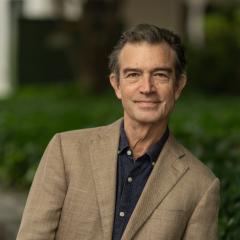
In this essay from 2026, Mitch Bogen takes a close look at Daisaku Ikeda’s 1993 Harvard address, “Mahayana Buddhism and 21st Century Civilization,” considering the deep meaning of Ikeda’s thoughts and their implications for not only our peacebuilding work at the Ikeda Center, but also all those working for a more harmonious, flourishing world.
*
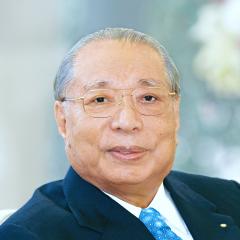
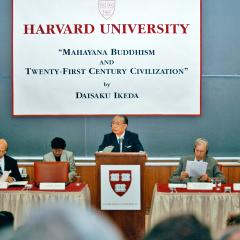
When Daisaku Ikeda delivered his lecture “Mahayana Buddhism and 21st Century Civilization” at Harvard Yenching Institute in 1993 it provided a powerful impetus for the establishment of our institution. Since then, this particular talk has become one of our core guiding documents, a fact that we are grateful for, since it represents a profound articulation of Daisaku Ikeda’s vision of Buddhist humanism and its implications for the cultivation of cultures of peace. It also provides critical points of focus for judging whether we are pursuing our value-creating, Buddhist-based peacebuilding work in the most effective manner possible.
Ikeda opens his talk in a curious and thought-provoking manner, focusing on what might be called the cosmic, metaphysical aspects of Buddhism, specifically the impermanent nature of life and the importance of perceiving of life and death as a unified whole. I say curious because he isn’t explicit what these important matters have to do with the work of peacebuilding and thought-provoking because Ikeda urges us to derive our own meanings from his reflections and to then use them as a subtext as we consider the three main topics of his talk. First, I’ll share some of his main opening reflections and then offer my own interpretation of why he begins this way.
“Everything, whether in the realm of natural phenomena or of human affairs,” observes Ikeda, “changes continuously, moment to moment. Nothing maintains the exact same state for even the briefest instant.” In Buddhism, he adds, this is referred to as “the transience of all phenomena” (Jpn. shogyo mujo). In particular, humans experience transience as the “four sufferings” of “birth (and the attendant pain of day-to-day existence), that of illness, of aging, and finally, of death—sufferings from which no one is exempt.” It is this last occurrence that Ikeda chooses to emphasize as the foundational idea for his lecture. He contends that over the last few centuries, as humans have developed as an increasingly scientific, materialist civilization, we have “attempted to forget and ignore death.” This is because “for modern humanity, death is the mere absence of life, blankness and void. Life is identified with all that is good, with being, the rational, with light; death is only evil, nothingness, the dark and irrational.” Ironically, notes Ikeda, as the denial of death took hold during the twentieth century, death itself only seemed to proliferate through mass warfare. Our way forward, he insists, will be to establish “a culture—based on an understanding of life and death and of life’s essential eternity—that does not disown death, but directly confronts and correctly positions death within a larger living context.”
The first thing that strikes me here is that Ikeda is urging us to move past a dualistic conception of life, for if we are inclined to think of death and disease as somehow “bad” and in opposition to life, what else might we cordon off as inimical to both our own interests and our fundamental nature? There is no limit to the damage that “othering” has done in our world. And what is the denial of death as the most fundamental form of othering? Differences and dualisms do exist in the biological and physical world of course, but the key is to understand that these exist within what Ikeda calls a “larger living context.” Similarly, differences among humans exist, but all humans are united through the experience of the four sufferings – as well as, we should add, the treasured experiences of love and care and companionship and everything that brings meaning and joy to life. Ultimately, what I think Ikeda is suggesting is that unless we have an accurate view of life, we will be unlikely be able to chart the courses of action that will benefit humans and the natural world. If your journey is across a sea, then you need a boat and not a car. If you want peace, killing people won’t get you there. If you want unity, an us-versus-them attitude won’t do.
I. Dialogue and Difference
Over the course of the lecture, Ikeda addresses three main topics derived from Mahayana Buddhism that he sees as essential to a twenty-first century that avoids the pitfalls of the twentieth. The first asks us to contemplate how, in Buddhism, peace, pacifism, and nonviolence flow from “its constant emphasis on dialogue, discussion, and language as a means of resolving conflict.” Ikeda shares how it was through words and explication of “the principles by which nations prosper and decline” that, late in his life, the Buddha dissuaded the leader of the powerful state of Magadha from seeking to increase its power by seizing the neighboring state of Vajji. And he also points out how, on his deathbed, the Buddha continued his dialogue with his disciples urging them to grow in knowledge and understanding of what we now know as the Buddhist Law, or dharma. “Why was Shakyamuni [Buddha] able to employ language with such freedom and to such effect?” asks Ikeda. “What made him such a peerless master of dialogue? In essence, he answers,
it was the embracing expansiveness of his enlightened state, utterly free of all dogma, prejudice, and attachment. The following words, attributed to him, are illustrative: “I perceived a single, invisible arrow piercing the hearts of the people.” This “arrow” could be termed the arrow of a discriminatory consciousness, an unreasoning emphasis on difference.
Ikeda observes that there, in the India of the Buddha’s time, the differences that people were most attached to were those of ethnicity and nationality, something also true of our age. And, crucially, in Ikeda’s telling this is not a problem that just other people have. “Indeed,” clarifies Ikeda, “the ‘invisible arrow’ of evil to be overcome is not to be found in races and classes external to ourselves, but embedded in our own heart.” Each of us needs to be honest with ourselves about when we are being “unreasoning” as opposed to thoughtfully discerning and compassionate about the differences in our world.
With Ikeda’s teachings and example in mind, at the Ikeda Center we build our dialogues and explorations around topics drawn from Buddhist humanism that elicit insights that not only are unique to each dialogue participant, but which also have the ability to unite us philosophically and interpersonally. Our assumption is not that we are all the same, but that our differences do not impede us from the possibility of understanding one another and developing together a shared vision for the wellbeing of all people. In all of his structured dialogues, such as those published by our Dialogue Path Press, Ikeda consistently opens by seeking to learn about his partner’s family and early years, with an ear toward those things that have contributed to their path in life. Along these lines, the late Vincent Harding, who was co-author with Mr. Ikeda of America Will Be!, always opened his dialogues by asking to learn about the other person’s grandparents. This method often produces a sense of warmth and connection that is salutary for meaningful conversation.
Before moving on from the topic of dialogue and difference, Ikeda notes that peacebuilding speech isn’t just “placid exchanges that might be likened to the wafting of a spring breeze.” Speaking of Nichiren, whose teachings form the foundations of the Buddhism practiced by the Soka Gakkai, Ikeda observed that he “was uncompromising in his confrontations with corrupt and degenerate authority.” In that spirit, Mr. Ikeda’s mentors in the practice of Nichiren Buddhism, Tsunesaburo Makiguchi and Josei Toda, both were imprisoned for opposing the imperial, militarist Japanese government of the early-to-mid twentieth century. Then, after WWII, Mr. Toda was fiercely adamant in his denunciation of nuclear weapons as an affront to human dignity and life itself. Today the Ikeda Center focuses a significant amount of its effort in trying to build a world free of these horrific weapons. While this commitment is unequivocal, the way we approach the cause is through the methods of dialogue and education that Shakyamuni Buddha modeled and which Mr. Ikeda himself devoted his life to.
II. Pragmatism and the Middle Path
In the second main section of the lecture, Ikeda poses questions which are profound in their implications not only for how we at the Ikeda Center pursue our work but also for how all those who desire that our religions have a truly positive effect on the world pursue theirs.
Does religion make people stronger, or does it weaken them? Does it encourage what is good or what is evil in them? Are they made better and more wise—or less—by religion? These, I believe, are the criteria we must keep firmly in view.
Immediately we see two intriguing things about Ikeda’s point of view. First, is that these questions are relevant not just to the conduct of religions but also to any guiding philosophy that people draw upon to act in the world. Indeed, here at the Ikeda Center we engage in dialogue and exploration about the way forward for society with all manner of people, including not only those from religious traditions but also scholars from all academic disciplines as well as diverse citizen peacebuilders and activists of all stripes. In every case, Ikeda’s questions help us judge whether we are proposing truly fruitful paths toward peace and greater wellbeing.
Second, the fact that Ikeda would even pose these questions in relation to religious practice reveals that his fundamental philosophical orientation is that of pragmatism, which identifies “truth” not in divine revelation, as in, for example, the dominant strains of Christianity and Islam, but in the evidence of lived reality. Pragmatism here is understood in two interrelated ways: first in the pragmatic nature of Buddhism itself and second in Ikeda’s appreciation of the pragmatic school of thought and action developed in the United States by figures such as William James and John Dewey. In fact, our Dialogue Path Press title called Living As Learning, authored by Mr. Ikeda in collaboration with Dewey scholars Larry Hickman and Jim Garrison, is a dialogue devoted in full to exploring the connections between the soka, or value-creating, form of Buddhism as expounded by Tsunesaburo Makiguchi and pragmatism as presented by Dewey, with attention to both the practice of education and the pursuit of personal and social development. In Living As Learning, Dr. Hickman described the resonance well, saying that:
the shared goal is promotion of the growth of each individual human within his or her social environment by the enrichment of the meaning of his or her life. When this is successful, we can say that value has been created. So it seems clear to me that Makiguchi’s concept of value creation and Dewey’s notion of growth are very similar. (p. 44)
As he proceeds with his talk, Ikeda draws attention to various aspects of the pragmatic orientation that are especially pertinent to our peacebuilding work. The first is that the orientation toward lived reality is resistant to the pitfalls of a philosophy that leans too much on abstraction, not least the tendency to treat individuals as nothing more than means to various ends. “Buddhism is not merely theoretical,” states Ikeda, “but seeks to enable us to guide our lives, moment by moment, toward happiness and value-creation.” From the start, Buddhism has been defined by the Buddha’s invitation to “come and see for yourself” (phrased in the Pali as ehipassiko) whether the teachings and practices such as meditation or chanting or practicing nonviolence are beneficial. One doesn’t practice Buddhism because an external authority has dictated that you must do so, with you then accepting dogma as a matter of faith and as a way to avoid punishment. Significantly, this rejection of the a priori truth of a given tradition opens the pathway to dialogue across differences, since actual experiences with growth and flourishing and interpersonal harmony, and the insights that arise from them, are hardly restricted to those of a certain religion or philosophy or scholarly discipline. We all can learn from one another. It is in this spirit that the Ikeda Center conducts all its programs and develops all its books. And it is in this spirit that we affirm the dignity of others.
The pragmatic orientation also resonates with the Buddhist advocacy of pursuing what is called the Middle Path, a matter that Ikeda emphasizes in his lecture. In particular, he discusses a key aspect of the middle way that people should pay attention to in the twenty-first century if we are to get past the kinds of conflicts that marred the previous one. Describing what he calls “steady progress” over the last few centuries “away from a God-centered determinism toward an ever-greater emphasis on free will and human responsibility,” Ikeda observes that, while beneficial in many ways, this movement also has hubristically “led humanity to believe that there is nothing beyond our power.” Further, explains Ikeda, “if past reliance on an external force led humanity to underestimate the full dimensions of our possibility and responsibility, excessive faith in our own powers has produced a dangerous overinflation of the human ego.” What Ikeda proposes is a “third path, a new balance between faith in our own power and recognition of that which lies beyond us.” Given the increasingly consequential split in US society, and indeed in the world, between religious believers and those of a secular orientation, this balance is greatly needed. Perhaps what is needed on all sides is some humility, which again, is inherent in the dialogical approach to life.
III. The Symbiotic Coexistence of All Things
To open his presentation of the third main point of his lecture, Ikeda cites a passage from the Lotus Sutra that he finds “particularly compelling,” namely that of “an impartial rain that compassionately moistens the vast expanse of the land, bringing forth new life from all the trees and grasses, large and small.” This scene, he explains is important for two reasons. The first is how it “symbolizes the enlightenment of all people touched by the Buddha’s Law of great and impartial wisdom.” Let us pause here for a moment and note that this impartial blessing of all people is a vital principle of nonviolent peacebuilding in all the world’s religions, thus making it a rich source for dialogue. For example, in Christianity it is known as agape, the unconditional love of all, even one’s enemies, that figured centrally in the philosophy of Dr. King and the Civil Rights Movement. (1)
For Ikeda, the passage is also important as “a magnificent paean to the rich diversity of human as well as all forms of sentient and insentient life, each equally manifesting the inherent enlightenment of its nature, each thriving and harmonizing in a grand concert of symbiosis.” Here, we have a vivid guiding vision for the Ikeda Center’s goals as an institution devoted to peace, learning, and dialogue in service of a society in which the flourishing of all people is a reality. In Buddhism, this symbiotic relationship is captured in the concept of “dependent origination” (Jpn. engi). This means, states Ikeda that “nothing—no one—exists in isolation. Each individual existence functions to bring into being the conditions that in turn sustain all other existences.” Here, Ikeda also states the concept in Western terms, quoting Goethe’s Faust, who asserted that “All weaves one fabric; all things give / Power unto all to work and live.” In modern ecological terms, we understand this system of pervasive relationship as interdependence. Ikeda is careful to clarify here that the Buddhist approach to this reality is not materialist or mechanistic in the sense that occurrences in life are random. To illustrate, he cites the teaching known as “three thousand realms in a single moment of life,” which the Soka Global website says “reveals that each individual life is a microcosm of the universe and the life condition of an individual at any point in time is reflected in all aspects of their life, including the society in which they live and the natural environment” – thus making it, states Ikeda in his lecture, compatible with the most recent developments in modern science.
Finally, Ikeda addresses the question of whether symbiotic interdependence diminishes and obscures individual identity and agency. Citing key Buddhist scripture, Ikeda argues the answer is no. “You are your own master. Could anyone else be your master? When you have gained control over yourself, you have found a master of rare value” (2). And elsewhere: “Be lamps unto yourselves. Rely on yourselves. Hold fast to the Law as a lamp, do not rely on anything else” (3). Here, he makes a crucial distinction that can help to illuminate and clarify the current debates in the US about the merits of individualism and collectivism. Typically, when excessive individualism is decried in our society what is being criticized is selfishness that either blindly or intentionally justifies succeeding at the expense of others. Ikeda has something else in mind. While “both passages urge us to live independently, true to ourselves and unswayed by others,” states Ikeda, the
“self” referred to here, however, is not what Buddhism terms the “lesser self” (Jpn. shoga), caught up in the snares of egoism. Rather, it is the “greater self” (Jpn. taiga) fused with the universal life through which cause and effect intertwine over the infinite reaches of space and time.
Moreover,
The “greater self” elucidated in Mahayana Buddhism is another expression for the kind of openness and expansiveness of character that embraces the sufferings of all people as one’s own, always seeking amidst the realities of human society ways of alleviating the pain, and augmenting the happiness, of others.
“I am firmly convinced that a wide-scale awakening to this greater self,” he added, “will give rise to a world of creative and symbiotic coexistence in the coming century.”
Though he doesn’t use the phrase in this lecture, we know from his voluminous writings that what Ikeda is describing here is what he calls “human revolution.” Earlier, when Ikeda spoke of the need to first attend to the arrow of prejudice in one’s own heart before combatting this evil in society, he was sharing a perfect example of the concept. Prioritizing “inward-directed change” in this manner, explained Ikeda in the introductory section of the lecture, will enable us to avoid the human rights abuses of the type that manifested in the revolutions of the twentieth century, which, in his view, focused too single-mindedly on the “reform of external factors.” For Ikeda the fulfillment of individual potential and the promotion of social wellbeing are two sides of the same project.
Conclusion – Nobility and the Treasure Tower
Ultimately, concluded Ikeda, the emergence of the greater self on a wide scale can be understood as the “solidarity” of a “natural human nobility” that has the capacity to “break down the isolation of the modern ‘self,’ opening horizons of new hope for civilization.” This choice of the word nobility is evocative and telling. Nobility is a state of being that is elevated, not through the mandates of others, but through the self-directed courage to think in the most affirming manner possible about our capacities as humans, and by the determination to see the best qualities of others manifested in their lives and in our world. In the teachings of Nichiren, observes Ikeda, this nobility is symbolized by what he calls “the treasure tower of our being.” It is with this image that Ikeda ends his lecture, offering a mission statement not only for the Ikeda Center but for everyone sharing the experience of being human:
It is my earnest desire and prayer that in the twenty-first century each member of the human family will bring forth the natural luster of this inner “treasure tower” and, wrapping our azure planet in the symphonic tones of open dialogue, humankind will make its evolutionary advance into the new millennium. Sharing with you this vista—of the brilliant dawn of a century of peace and humanity—I conclude my remarks.
Notes
1. Employing strikingly similar imagery to the Lotus Sutra, Matthew 5:45 of the King James version of the Biblical New Testament illustrates the divine impartial love of agape in this manner: God “maketh his sun to rise on the evil and on the good, and sendeth rain on the just and on the unjust.” In 2011, Vincent Harding discussed related ideas in his video: “Love and the Struggle for Social Transformation.”
2. Translated from Japanese. J. Takakusu, ed., Nanden daizokyo, vol. 13, p. 1ff.
3. Translated from Japanese. J. Takakusu, ed., Taisho shinshu daizokyo, vol. 1, pp. 645c, 15b.