Anita Patterson Delivers Indigo Talk on Ikeda, Literature, and Dialogues of the Heart
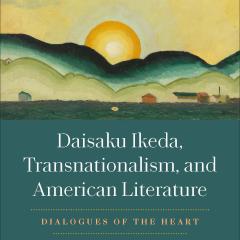
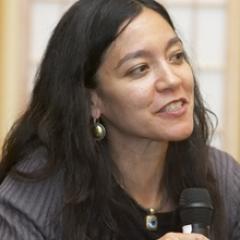
For the 2026 Indigo Talk, the Ikeda Center welcomed Anita Patterson, Professor of English at Boston University and editor of Daisaku Ikeda, Transnationalism, and American Literature: Dialogues of the Heart (Routledge, 2026). “In addition to her many accomplishments,” said event moderator Lillian Koizumi by way of introduction, “Dr. Patterson is one of the Center’s dearest friends, and we have been profoundly grateful for the opportunity to get to know and learn from her over the years. Not only is she a brilliant scholar, but she is truly an incredible human being.”
Koizumi also shared thoughts on the Indigo Talks speaker series, which, she said, derives its name from the Buddhist expression, “from the Indigo, an even deeper blue.” What this means in the context of this series, in which renowned scholars engage with key aspects of Daisaku Ikeda’s philosophy, is that “just as items repeatedly dyed with indigo turn bluer than the indigo itself, the Chinese allegory of the indigo plant, exemplifies the impact learning has on deepening one’s wisdom, courage, and compassion.”
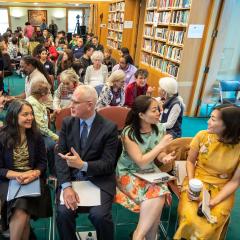
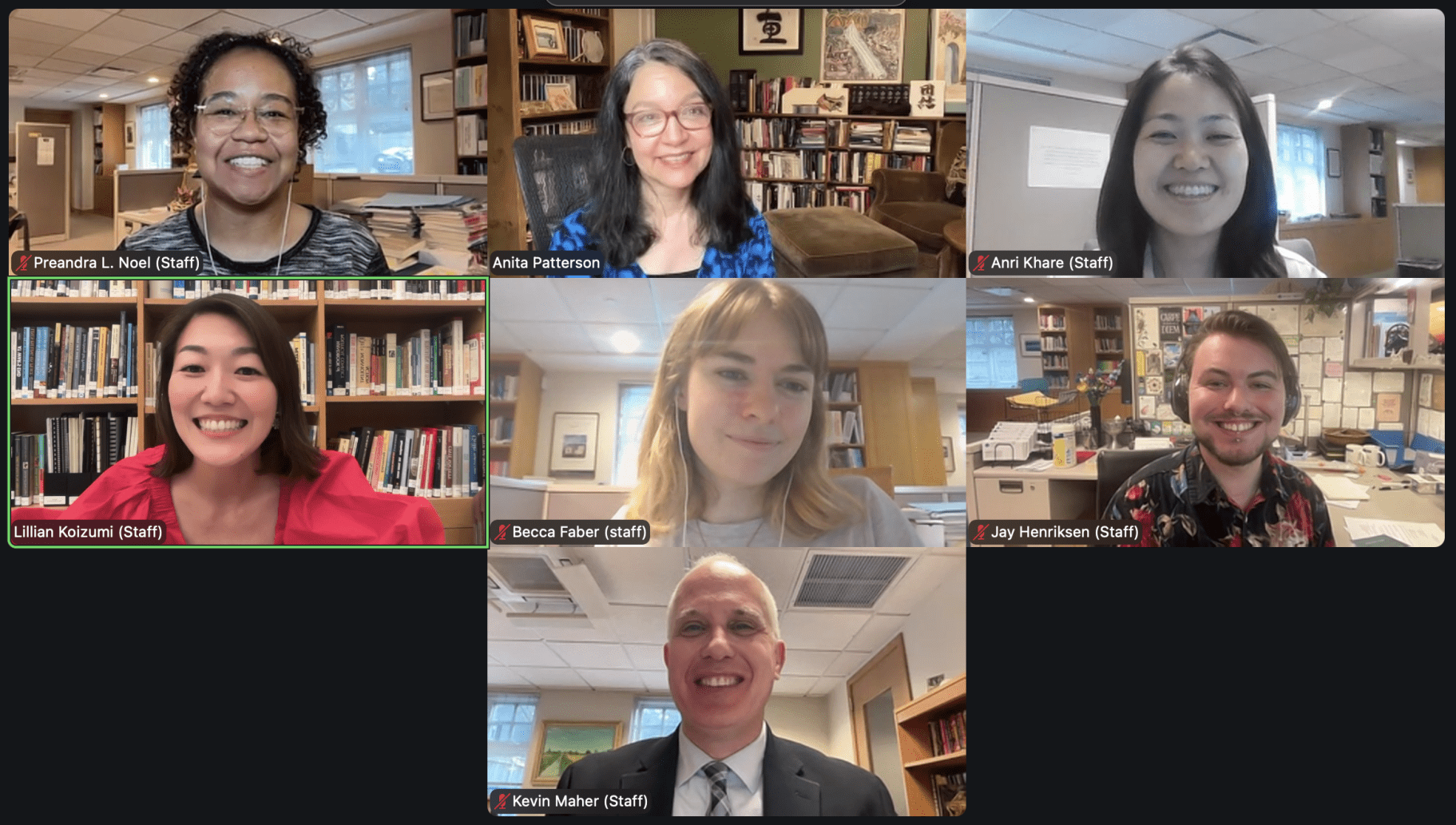
As the Ikeda Center’s only virtual event, the Indigo Talks allow for attendees across continents and time zones. For this year’s event there were 184 participants from 18 countries: Argentina, Australia, Bolivia, Brazil, Canada, Dominican Republic, France, Germany, Hong Kong, India, Italy, Japan, Malaysia, Mexico, Morocco, Norway, Qatar, and the United States.
Literature and the Dialogical Deepening of Understanding
During her prepared remarks, said Dr. Patterson, she would explore themes from the new multiauthor volume, in which “contributors collectively explore Ikeda’s writings in an interdisciplinary context in order to understand the immediacy and transformative power of literature and philosophy, especially their capacities to inspire transnational dialogue.” But driving these scholarly goals, is something deeper, she said. For her, the impetus for the book could be traced to the emotional power of Mr. Ikeda’s recollections of his youth in post-war Japan. First, she cited his reflection that:
Growing up in Japan during World War II taught me all I will ever need to know about the suffocating realities of a militarism that will not brook free and open discussion. This experience instilled in me the conviction that dialogue is a bastion protecting human dignity against the assaults of violence, an essential force for the creation and expansion of peace.
Then she cited Ikeda’s lines of poetry describing the key poetic influences for him in those same post-war years: “Since my youth, years ago, / Emerson and Whitman have been / My constant companions. / We have talked together—a dialogue of the heart.” And in another poem he pinpointed what he gained from these dialogues of the heart, namely “the strength and courage to live” when confronting “the implacable / Challenges of life.”
As a scholar whose interests include the literature of the American Renaissance, Dr. Patterson perceives Ikeda’s engagement with these authors to be both interesting and inspiring on its own terms but also of scholarly interest as a modern manifestation of ongoing transnational dialogue. An aspect of her talk that was especially illuminating featured her delineation of the earliest instances, in the nineteenth century, of Americans engaging with key Buddhist texts and making them available to the public. For many of us, our notions of American involvement with Buddhism mostly concern the great post-war boom that focused to a considerable extent on Zen and Tibetan Buddhism. But Ikeda’s interest in and connection with the American Renaissance connects us with the spirit of discovery and transnational dialogue that flourished in the previous century.
Among the key Ikeda observations that Dr. Patterson shared during her talk was his insight that Emerson’s landmark essay Nature possessed critical resonances with Buddhism, particularly with the concept of dependent origination. “This is the teaching,” wrote Ikeda, “that all phenomena are connected, and none exist independently. All things are joined in a great web of interdependent connections, which ultimately constitutes our cosmos. True human happiness is born from expanding our awareness of this integration.” She also described her interest in another aspect of transnational literary dialogue – this found in Ikeda’s 1991 Harvard lecture on the topic of “soft power.” In it, Ikeda noted that Theodore Roosevelt’s encounter with the Japanese literary classic Bushido enabled him to better understand the “Japanese character and spiritual education,” thus contributing to his mediation of the settlement to the end of the Russo-Japanese War in 1905.
Moving to a more personal perspective, Dr. Patterson said that “I am drawn to Ikeda’s dialogues of the heart with Emerson and other American authors as a means of fostering peace and intercultural understanding, in part because of the experience of my own Japanese American mother during World War II.” As a youth during the war she had been sent with her family to an “internment” camp in Arizona. From there she received a scholarship to spend her senior year at the Cambridge School in Weston, Massachusetts. Not long ago, Dr. Patterson discovered a “treasure trove” of papers left behind by her mother, which included “an essay she had written in 1944 about T. S. Eliot for a class at the Cambridge School. Eliot, who was influenced by both Buddhism and Emerson, is a poet I have cherished and studied for decades,” said Patterson. Thus, she was pleased to find out that Daisaku Ikeda also valued Eliot. As an example, she cited his 1984 lecture on “Humanity in Education,” in which he praised Eliot’s view that “culture is living,” and that education must broadly cultivate individuals so that they become “truly international.”
Professor Patterson also spoke of her appreciation for Mr. Ikeda’s perspective on Dr. Martin Luther King, Jr., who figured significantly in her own book of 1997, From Emerson to King: Democracy, Race, and the Politics of Protest. Referencing Ikeda’s 2013 dialogue with the historian Vincent Harding, America Will Be!: Conversations on Hope, Freedom, and Democracy, she observed that their conversation “raised my awareness of Buddhist resonances” in King’s “philosophy and peacebuilding legacy.” In addition to applying the concept of dependent origination again – connecting it to King’s ideal of the “beloved community,” where all life is an “inescapable network of mutuality, tied in a single garment of destiny — Mr. Ikeda also identifies the Buddhist figure of the bodhisattva as especially relevant to King’s vision. “Buddhists identify the struggles of…King,” said Ikeda, “with the attitude a bodhisattva described in the Lotus Sutra named Never Disparaging”:
He tells everyone, “I have profound reverence for you. I would never dare treat you with disparagement or arrogance. Why? Because you are all practicing the bodhisattva way and are certain to attain Buddhahood.” Although people ridiculed him and attacked him with sticks and stones, he simply went about bowing to them and continued his non-violent practice.
Here, Dr. Patterson shared an interesting resonance between the views of Ikeda and King that she recently encountered during her research. In 1950, when King was a student at Crozier Theological Seminary, he wrote a paper arguing that Christian ethics find confirmation in the figure of the Boddhisattva, “the earnest seeker after the welfare of others, who in unselfish devotion to his fellow creatures accumulates great stores of merit and dedicates it not to his own salvation but to that of all suffering beings.”
Before moving to a discussion of the new book, Dr. Patterson said, “I hope I have given you some indication of how indebted I am to Daisaku Ikeda for his reflections on American authors whose works are central to his global peacebuilding and human rights agenda.” In particular, she added, “he has strengthened my belief, as a teacher and scholar, that reading literature can foster dialogue, both inside and outside of the classroom, which will enable us to flourish, even in chaotic and divisive times.”
Like the other of the Ikeda Center’s most recent titles, Daisaku Ikeda, Transnationalism, and American Literature: Dialogues of the Heart is a multi-author volume, in this case featuring a blend of esteemed veteran and emerging scholars. Explaining the purposes of this landmark book, Dr. Patterson said, “taken together, the chapters collected in the volume survey the broadening scope of Ikeda’s dialogues of the heart with American authors by advancing Ikeda’s legacy of close, sustained engagement with a diverse array of texts, ranging from the authors of the American Renaissance; to the philosophical pragmatism of John Dewey and Martin Luther King Jr.; to a global culture of letters, extending from Ralph Ellison and Muriel Rukeyser to Wole Soyinka and beyond. [for details on authors and chapters go here]
As she wrapped up her overview of the book, Professor Patterson offered her thanks to the “wonderful contributors” and “her friends at the Ikeda Center,” saying that “working with this community has taught me a profoundly life-affirming lesson, namely, that what Ikeda described in 2002 as the ‘path called dialogue’ is integral to our capacity to hope.” Then, citing Ikeda’s reflections on his dialogue with Arnold Toynbee, she said she appreciated his view that “dialogue [is] the path we should take as human beings to melt the walls of mistrust dividing us.” And finally, employing sentiments that could pertain both to the publishing of the book and the achievement of peacebuilding goals, Dr. Patterson said she “wholeheartedly agreed” with Mr. Ikeda’s conviction that: “When we change our inner determination, everything begins to move in a new direction. The moment we make a powerful resolve, every nerve and fibre of our being will immediately orient itself towards the fulfillment of this goal.”
Q & A: Meaningful, Heartfelt Engagement With Literature
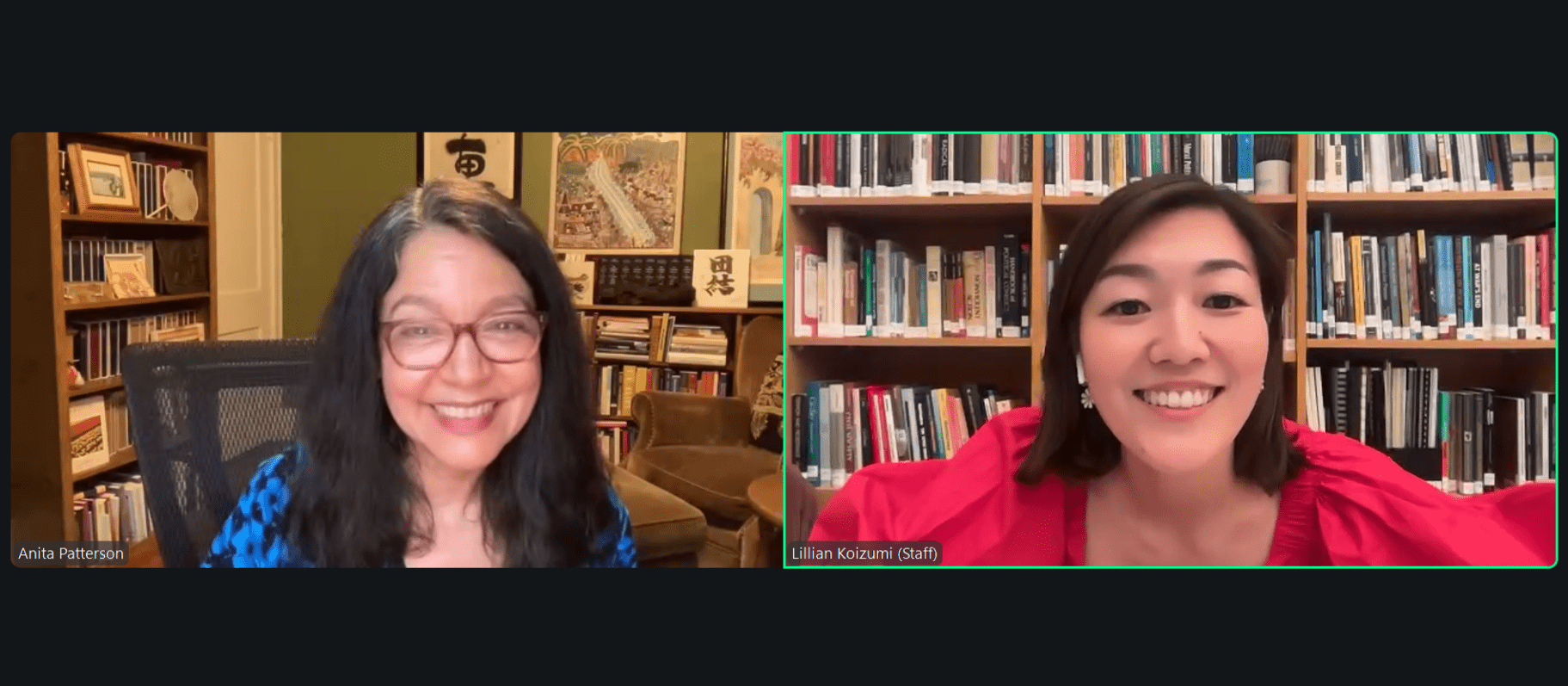
Before moving to the Q & A portion of the evening, Lillian Koizumi thanked Dr. Patterson for her “deeply inspiring, enlightening, and really timely talk.” In particular, she added, “I also love how in the end you shared that a dialogue of the heart involves a decision, first and foremost. And I was thinking that this kind of courage is what we all need, especially right now, to engage with others and the world around us.” She then invited attendees to pose questions for Dr. Patterson, saying that this “is often my favorite part because we get to hear from the audience.” Here are summaries of the topics raised during Q & A along with excerpts from Dr. Patterson’s responses.
On literature’s unique power to both entertain and to expose us to the “suffering, joys, complexities, and potentialities of human nature.”
“Both of these dimensions of literature play a very important role, I think, not just in our own reading on our own, but also in the classroom. I think there’s a sort of miracle in the fact that we can be simultaneously entertained, but also inexorably drawn into this kind of deeper understanding of ourselves and the world around us… . [And] I try to encourage my students not only to be sort of self-revelatory in our conversations about literature, but also to realize that whatever they read in the classroom is something that can be a sort of sustaining source of reflection and self-understanding in years to come [in ways] that they won’t even know.”
On helping students move beyond viewing literature as simply an academic requirement and instead experience it as a source of personal growth and deeper understanding.
“I do what are called breakout groups during the class, where I have students move their desks so that they’re in smaller groups of three or four. And I’ll present them with a text, with a kind of quote or question about a text. And then I’ll go around, I’ll be like a game show host. I go around to each group and I talk to the students directly. And because they’re not on camera and trying to participate within the larger group, everyone relaxes, and it becomes more of a real conversation. And I’ve said this before in the context of an Ikeda Forum, but there’s something about literature, the fact that you can be talking about an object, an external text, but revealing something about yourself in the process, that makes for a very, very kind of generative, discussion. And so for me, I cherish those times: Learning about their responses to the texts that we read, and also understanding that they are not quote-unquote specialists. But that’s part of what gives the classroom such vitality.”
On the centrality of student engagement.
“You learn so much from undergraduates about how to put complicated ideas into simple language and it’s a kind of visceral experience because if they don’t understand what you’re saying, the facial expressions just totally turn off. [So when] reading intimidating literature, intimidating scholarship, [I endorse] the practice of putting it into ordinary language. I always joke, I’d say if you had to tell your mother what you were studying, you’d be able to translate it into kind of ordinary language. You know, that’s so important because people turn off when they’re intimidated.”
On Ikeda’s view of literary engagement as a deliberate mode of peacebuilding and hope-making.
“Well, first, let me just say, I can’t stress enough how inspired I am by Ikeda’s conception of hope is a decision. We talked about this before, but in these times I wake up some mornings thinking about that truth. And I think that there’s no question that reading in a way that is active and engaged, is a kind of decision that we make on an everyday basis. And I think it’s important to realize that, for example, how Thoreau, when he wrote “Civil Disobedience” didn’t really know that what he was going to do would have such incredible repercussions for political activism and belief in American society. I don’t think any of us knows, when we make a decision on what to do today, what the repercussions will ultimately be. In other words, seeing these writers as participants in a culture of engagement and decision-making is important, not just for what they’ve done and for us to be able to see their achievements, but also for us to take inspiration and realize that these are individuals that didn’t have the assurance that they were going to last. So I’m just hoping that people who read now understand that and learn that reading is a kind of active engagement, and that we learn by revisiting texts that we thought we knew.”
On the meaning of Dialogues of the Heart.
“I mean, it’s such a profound phrase, and Dialogues of the Heart can mean a kind of engagement and love for a person. It can also mean that works of art over the years become more than just objects. They’re really people, they’re sources of wisdom, of self-awareness, and I love the fact that Dialogues of the Heart is something that extends not just to these literary texts, but to others and that there’s a profound way that our reaching out to works of literature and all these other times and places is in itself a kind of gesture and decision-making about the world that is becoming open to us. And I’m so pleased that the phrase dialogues of the heart just sort of stuck, because, it is a phrase that I find myself revisiting, and I’m learning more about it each day.”
Closing Thoughts: Literature As Peacebuilding
To begin, Ikeda Center executive director Kevin Maher expressed his gratitude to all those who attended, “from so many countries and time zones.” And then, speaking “on behalf of the entire staff,” Maher shared his “deepest appreciation to Dr. Patterson for your illuminating and deeply inspiring presentation,” adding that “what especially resonated with me was your exploration of literature not simply as a field of study, but as a living practice of dialogue and inner transformation.” And is often the case, Maher concluded with the thoughts of Center founder Daisaku Ikeda. Here, he quoted from Ikeda’s message to the 2023 Ikeda Forum, which featured Dr. Patterson in dialogue with many of the contributors to Dialogues of the Heart. “In the early postwar years,” wrote Ikeda,
my mentor in life, Josei Toda, employed literary masterpieces of the world to inspire and tutor me and other youth under his care. While sharing in our perspectives on the universality of life, a dimension so vast as to transcend the ages and nation-states, race and religion, Mr. Toda further opened our minds to a new vision of the means of uniting humanity in harmony: the principles of “human revolution” and “global citizenship.”
In the years that followed, as a protégé embracing Mr. Toda’s vision as my own, I set out on a journey across the world in the hope of bringing countries closer together. In doing so, I also sought to draw lessons from the finest literature of each country and share the deep emotions they evoked. For I firmly believe this evocative capacity of literature intimately resonates with the “dialogues of the heart” that nurture an inner transformation of our lives and the spirit of peace.