Stephen Herzog: Engaging with Deterrence Advocates and Arguments
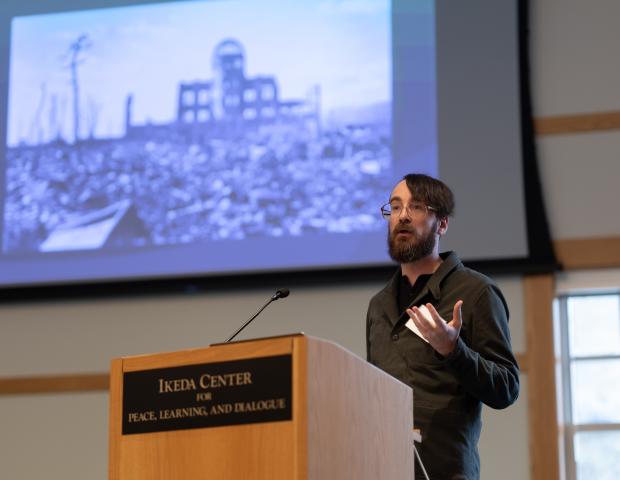
In conversations with many of the participating teachers leading up to the 2026 Educating for Peace conference, topics such as the current political climate and the escalating wars around the world continued to come up. With that in mind, the conference organizers were thrilled to have Stephen Herzog, a leading authority on both the science of nuclear weapons and the range of possible strategies to achieve the urgent, vital goal of disarmament, as one of the keynote speakers. To cite just a few examples of his wide-ranging experience, Dr. Herzog is Professor of the Practice at the James Martin Center for Nonproliferation Studies (CNS). He also is Academic Co-Chair of the Beyond Nuclear Deterrence Working Group, an initiative of the MacArthur Foundation and Harvard University’s Project on Managing the Atom. Prior to joining CNS, Dr. Herzog was a Senior Researcher in Nuclear Arms Control at ETH Zurich, the Swiss Federal Institute of Technology. He has also been a Research Fellow at the Harvard Kennedy School’s Belfer Center for Science and International Affairs, as well as a US Department of Energy nuclear arms control official.
Addressing the Eternal Divide
To open, Dr. Herzog said he would be addressing the “eternal divide or so-called divide between people who are proponents of nuclear deterrence and proponents of nuclear disarmament.” Specifically for this disarmament conference he would focus on the question of what are the best approaches and attitudes toward engaging with and persuading those who “don’t buy the logic” of disarmament. Should we “stigmatize” them? Say they are “wrong”? “How do we talk with them and negotiate with them?”
As a starting place he said we have been engaged in a “more than 80-year-old status quo where many governments claim to rely on nuclear weapons for safety and security.” That is, beginning with the bombings of Hiroshima and Nagasaki the consensus opinion has been that the bombs ended the war earlier than it otherwise might have and countless American and even Japanese lives were saved. Instead of just accepting this narrative, teachers can lead students in researching and debating this assumption – an assumption that provides the very foundation of the deterrence approach to nuclear weapons. Indeed, there are many perspectives that question this narrative, including the interesting point that many school systems in the Former Soviet Union teach their students that it was Moscow’s decision to engage in the Eastern theater against Japan that hastened Japan’s surrender.
When teaching disarmament issues, it’s important to place deterrence theory in context, said Herzog, emphasizing several key points that teachers and students can engage with. First, he said we need to understand that, as horrific as the Hiroshima and Nagasaki bombs were, today’s weapons are immensely more powerful and destructive, on a scale that can hardly be imagined. Another interesting topic is that of the “stability/instability paradox.” Supporters of deterrence assert that the nuclear standoff has kept us from another world war, proving what can be called “macro peace.” But lower-level armed conflict has been nonstop since the end of WWII. “Does that mean,” asked Herzog, “that nuclear weapons provide peace, or does it mean that we’ve just “outsourced conflict and casualties to the developing world?”
It is also crucial to understand, said Herzog, that deterrence theory as we know it today was actually developed in the 40s through the 60s, which means it rests on outdated concepts, not least that of a “bipolar” world in which nuclear competition primarily took place between the United States and what was then the Soviet Union. With nine countries now possessing them it makes the calculus of agreement and deterrence considerably more complex, not just because of the number of state possessors and modern weapon technologies but because today’s leaders inevitably have different concerns and mindsets than did the Soviet and US leaders of past decades.
To conclude his points of engagement Herzog introduced an intriguing analogy that rests on the pretty-undebatable idea that “people do dumb things.” Consider drinking and driving, he said. A typical person, not someone with a problem per se, might have three drinks or so when they go out to dinner with friends. And even though this might put them above the legal limit, they go ahead and drive home. This is a dumb thing to do, said Herzog, and “just because nothing bad happened” doesn’t mean it was wise or safe, or, critically, would be safe in the future. The same thing can be said about the nonuse of seat belts or countless other instances of risky behavior. This is precisely the situation with the incredibly more fraught case of nuclear weapons, in which countless close calls and mistakes have brought us to the brink of catastrophe, with the worst case being avoided through either luck or the actions of alert individuals.
Next, Herzog discussed the matter of how best to engage with proponents of deterrence. The first thing to understand, said Herzog, is that while most people say they care about nuclear weapons, when they are polled on their top ten issues of concern nuclear weapons come in near the bottom. For the average person looking out for their family, he said, things that relate to the challenges of getting through everyday life matter most. So for the disarmament activist it’s critical to acknowledge that
we are all humans and we all care about our families and safety and security and things like this. Which means that if you have students in the classroom or friends or colleagues who are strong advocates of nuclear deterrence, we shouldn’t be villainizing them or demonizing them.
So there really is some “common ground to talk about,” he added. For example, “engage them on risk,” “engage them” on whether these weapons really keep us “safer.” Somehow, we need to move beyond the current state of polarization in which disarmament people are portrayed as naïve “hippies” and the deterrence policy is portrayed as tantamount to murder. Indeed, “I don’t think polarization helps a lot for those of us who support disarmament because deterrence is the status quo and polarization is possibly the last thing we need.”
Finally, he concluded his prepared remarks, saying, “the rhetoric of stability with nuclear weapons and the rhetoric of deterrence is this antiseptic rhetoric, which is so detached from” the complex and dire threat of nuclear weapons. Further:
This is something that we cannot forget that needs to be taught in classrooms. And if you have students, if you have friends, et cetera, who are proponents of deterrence, they should grapple with the humanitarian consequences and think about why the world that they want is [actually] less risky and less dangerous, because I would prefer that this never happened again, and it cannot happen again.
Q & A
The first question during the Q & A following Herzog’s talk was a challenging one: If nuclear weapons represent an absolute and not even a relative evil are there limits to or drawbacks involved with engaging with deterrence advocates and arguments? In response, Herzog explained that in his experience many disarmament programs don’t teach deterrence at all. Some programs are trying to address that and have invited him to lecture. Though the result has been that, at one university in Europe, the first few times “I gave this talk about deterrence and about nuclear weapons effects, I had students walk out on me.” But what he wants to communicate to extreme skeptics like this is that if “we want to get rid of nuclear weapons and we want to make the case, the best case against nuclear weapons is the exact way the advocates of deterrence have thought about using nuclear weapons and laid out the case.” What you need to do is “interrogate those assumptions” that nuclear weapons actually increase security and that making populations vulnerable and holding them hostage is the path to stability and safety. In other words, “I am literally engaging [them] on their own terms.” As for using the language of evil, it should be pointed out, he said, that “there are people who believe that deterrence is an absolute good, who seem to be unshakeable in their moral belief and almost theological conviction in nuclear deterrence. And sadly enough, when you argue disarmament and nuclear weapons are evil to them, it can sound like a personal insult.”
Here, Dr. Ira Helfand added that the vast majority of the public believes in deterrence, and they believe in it for good reasons. They think it makes them safe and they think it makes their family safe.” This means that the crucial thing is “recognizing the psychology behind their commitment to deterrence and how deeply rooted this idea that strength equals safety is.” If, in the past, having strength superior to your adversary enhanced your security, today this is no longer true, said Helfand. Any use of nuclear weapons at all would be catastrophic, even if the target nation doesn’t respond. Nuclear weapons are essentially suicide weapons for anyone who uses them, he said, which makes the notion of security through strength a thoroughly moot point. Just to underscore Helfand’s remarks, Dr. Herzog noted that in a project he is working on “what we find is that people are most able to understand the negative things about deterrence when it’s framed in terms which matter to their lives and their locality.”
With just a brief amount of time, Herzog quickly fielded a few more questions. The first raised the question addressed whether nations would ever be able to overcome the distrust they have for one another in order to cooperate to achieve nuclear disarmament, and what would you say to those that say we will never overcome that? To the skeptics, Herzog said he would argue a couple things. First, the disarmament movement is here precisely to show the achievable path to disarmament. And secondly, isn’t all that mistrust the best reason of all to disarm? Next, a person asked: “how do we put forward the idea that yes, coexisting peacefully with all the people who currently exist on the planet is feasible in the future, in the environmental future that we face?” Joking that he would have the Nobel Peace Prize if he had an answer for that, Herzog said that she raised an important point. “All of the things that we try to do to quote solve one existential risk,” he said, “whether it’s nuclear weapons, whether it’s the militarization of AI, whether it’s climate change, are probably all interlinked, and pulling or tugging on one existential risk can potentially take us to the brink with another existential risk.” The next question dealt with the problem involved in getting nuclear arms manufacturers to “pivot” away from that lucrative work. This is an interesting question, said Herzog. One thing that makes him optimistic in this regard is that most manufacturers in this field actually produce many things in addition to nuclear weapons, so it is not an all or nothing situation.
Finally a participant asked if they could return to where he started with his talk, that is, addressing issues relating to the end of World War II. What should teachers be focusing on? Citing the scholar Ward Wilson, Herzog said that he really does think there is something to the idea that the Soviet Union joining the war in Asia was a motivating factor for Japan surrendering. After all, they had already sustained an extremely high number of casualties in the fire-bombing of Tokyo, so the nuclear casualties of Hiroshima and Nagasaki were not necessarily fully unprecedented. Ultimately, Herzog said that “what I would say is this. I would say there are probably a number of different things which contributed to Japan’s eventual surrender. It’s difficult to go through and to disaggregate which one it is, but we need to be teaching multiple [theories] at once.” The bottom line, said Herzog, is that questioning the “war winning” argument is vital, since it “uniquely feeds” into our current status quo of nuclear deterrence.